
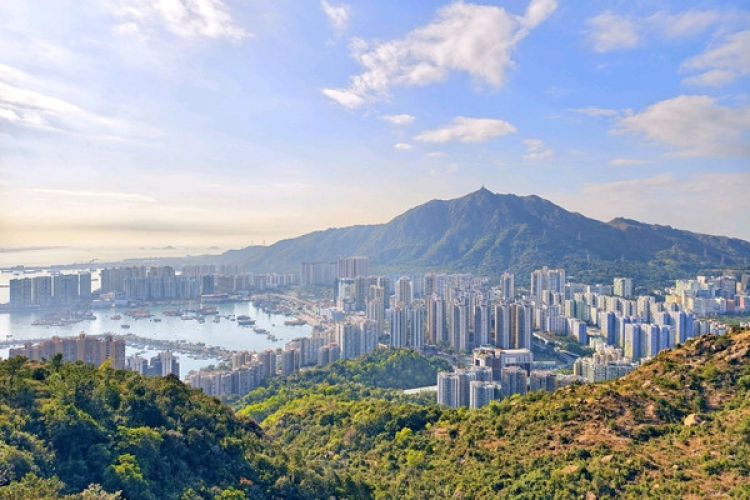
The previous article discussed the feng shui of Yuen Long. This time, let’s talk about Tuen Mun, one of the few districts in Hong Kong that has the dual identity of being both a place with over a thousand years of history and a modern new town. From an ancient coastal military stronghold to today’s densely populated core of western New Territories, its development path reflects not only historical change but also the influence of geography and feng shui patterns.
This article will begin with the historical background, then further analyze Tuen Mun’s mountain-and-sea formation, and focus on the feng shui strengths, weaknesses, and development trends of different parts of Tuen Mun under the Ninth Period.
Tuen Mun Through the Ages: From Military Town to New Town
The name “Tuen Mun” itself reveals its military origin — it means “the gate where troops are stationed.” As early as the Southern Dynasties, religious activity had already been recorded in the Castle Peak area. By the Tang Dynasty (736 AD), the imperial court officially established a military garrison in Tuen Mun, stationed troops there to defend the Pearl River Estuary, making it an important base for coastal defense in Lingnan.
Because Tuen Mun is surrounded by mountains on three sides and faces the sea, it naturally controls the mouth of the Pearl River. Since ancient times, it has been an important node on the Maritime Silk Road. Merchant ships traveling between Southeast Asia and the Middle East often had to pass through here on the way in and out of Guangzhou, so Tuen Mun can also be regarded as Guangzhou’s outer port.
During the Ming Dynasty, Tuen Mun became a frontline battleground where Eastern and Western powers clashed. In the Tuen Mun Naval Battle of 1521, the Ming navy repelled the Portuguese fleet here, showing the area’s strategic importance.
In modern times, Tuen Mun gradually shifted from a military stronghold to an agricultural and fishing community. By the early 20th century, with the opening of Castle Peak Road and the formation of Tuen Mun San Hui, more substantial market and commercial activity began to emerge in the area.
The real turning point came in the 1970s. The Hong Kong government under British rule planned Tuen Mun as one of the first-generation new towns, carrying out large-scale land reclamation and building public housing estates and industrial areas. This rapidly transformed it from a rural district into a modern city. After the West Rail opened in 2003, Tuen Mun was fully integrated into Hong Kong’s transport network, and its development entered a new stage.
Tuen Mun Feng Shui: Where Mountains Meet the Sea
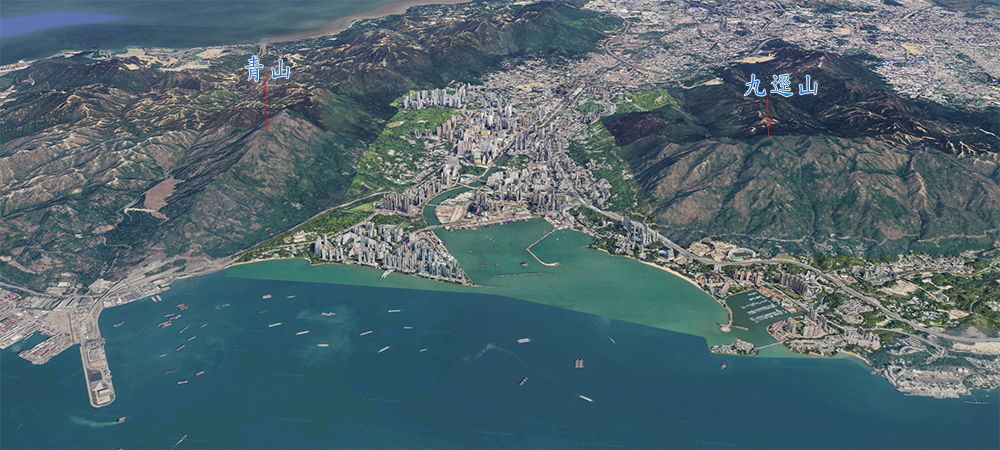
From a feng shui perspective, the core of Tuen Mun lies in the interaction of qi among Castle Peak, Kau Keng Shan, and the Pearl River Estuary.
- Castle Peak: Standing close to the Pearl River Estuary, it directly receives strong qi flows from the southwest, especially from the Lantau and Zhuhai direction.
- Kau Keng Shan: Located on the eastern side, it serves as a support mountain that gathers and buffers qi.
- Tuen Mun River and the bay: In certain areas, these provide circulation and regulation of qi.
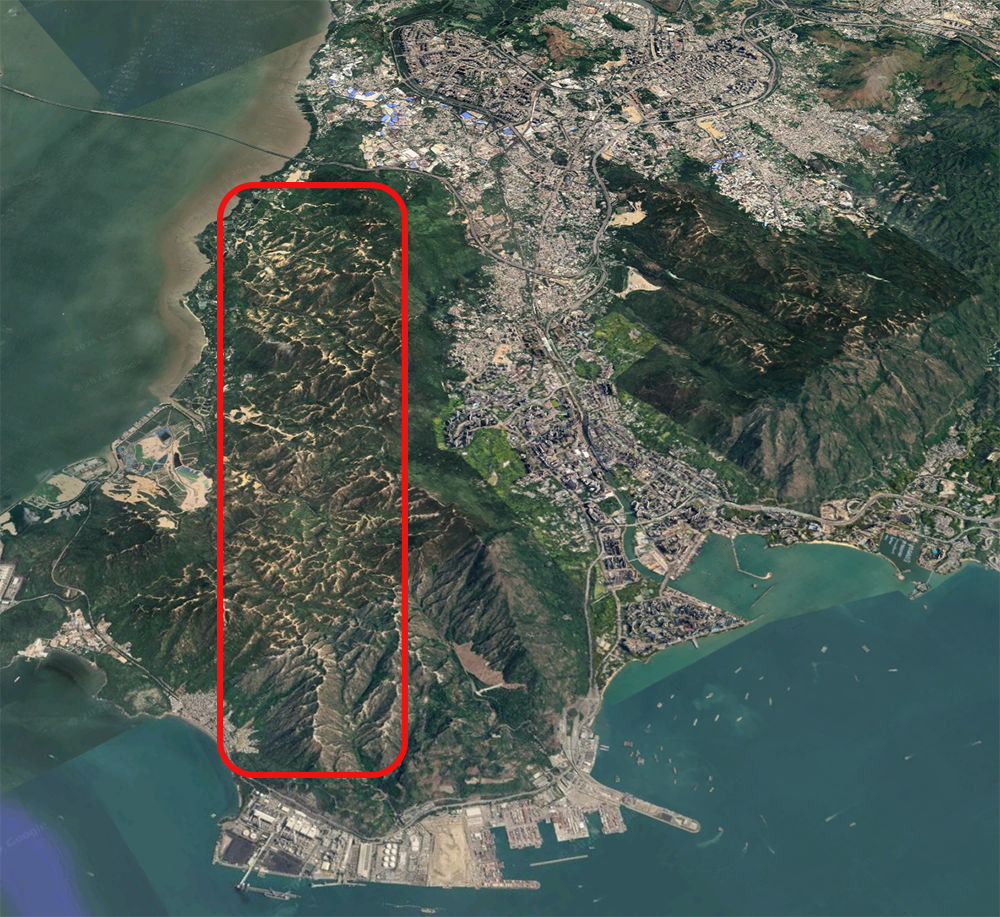
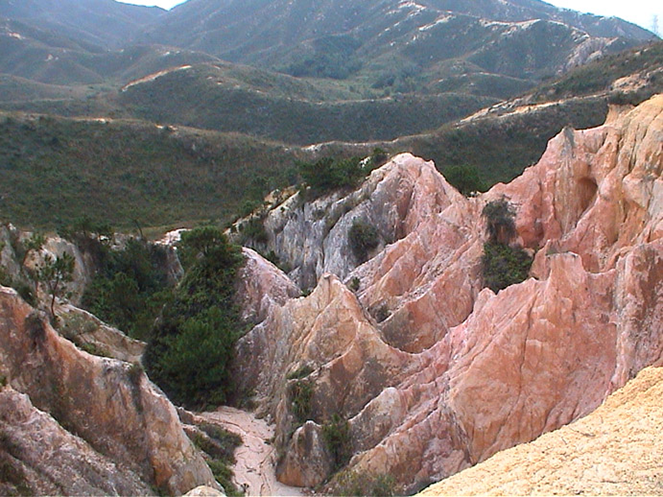
One major feature of Castle Peak is the large-scale erosional ravine terrain on its left side, facing the Pearl River Estuary, including areas such as the Castle Peak hinterland, Crescent Valley, and Tsing Chung Red Crag. In feng shui terms, this terrain is often seen as the result of qi moving too aggressively and creating sweeping sha qi.
The left side of Castle Peak absorbs intense qi impact, which helps keep the Yuen Long Plain relatively stable; however, part of the sha qi still crosses the ridge and settles around central Tuen Mun.
As a result, Tuen Mun presents a complex pattern of localized sha influence but overall usability. It is not uniformly bad; rather, the qi quality differs significantly from one location to another.
Period Eight and Period Nine: The Shift in Qi
Tuen Mun’s rise closely matches the cycle of the “Three Yuan Nine Periods.” During Period Eight, auspicious qi moved toward the southwest, which happened to align with Tuen Mun’s position. The opening of the West Rail in 2003 also coincided with this qi movement, accelerating the district’s overall development.
During this period, the southwest auspicious qi further suppressed the sha qi on the left side of Castle Peak, and Tuen Mun gradually became an important residential and transport hub in the western New Territories. In that sense, Tuen Mun’s real breakthrough was directly linked to the twenty-year qi shift of Period Eight.
Entering Period Nine, the qi field changes noticeably: auspicious qi shifts from the southwest to the northeast, the sha qi on the left side of Castle Peak becomes active again, and the qi in central Tuen Mun is more likely to move toward the northeast and north.
This means that the feng shui focus of Tuen Mun will undergo a structural shift. Areas that benefited in Period Eight may not enjoy the same advantage in Period Nine; on the other hand, some areas that were previously less prominent may gradually gain strength.
In the Ninth Period: Where Is the Best Feng Shui in Tuen Mun?
Based on mountain form, water flow, and qi movement, Tuen Mun in Period Nine can be divided into three levels:
- Best area: Tuen Mun North to Hung Shui Kiu. This zone is close to the Yuen Long Plain, which is a gathering place for qi, and it lies along the northeast direction of qi movement, away from the direct influence of Castle Peak’s sha qi.
- Strong area: So Kwun Wat and Gold Coast. These locations have Kau Keng Shan as a backing mountain, a stable structure, and an open sea-facing layout that collects auspicious qi. They remain high-quality residential zones.
- Relatively weaker area: Tuen Mun town centre. This area sits within the zone where Castle Peak’s sha qi descends. After the auspicious qi shifts away, it becomes harder to gather qi, and the energy field is more unstable.
If viewed from the perspective of residence and long-term planning, Period Nine is more suitable for focusing on northern Tuen Mun, the Hung Shui Kiu extension area, and the mountain-and-sea setting around So Kwun Wat. In terms of commerce and flow, Tuen Mun town centre still has its function, but it may not be the best place for long-term wealth accumulation.
The Intersection of History and Feng Shui
Tuen Mun’s development is a classic example of how site luck and human activity work together: in ancient times, its terrain made it a military and trade hub; in Period Eight, it rose in line with the movement of qi and became the core of new-town development; in Period Nine, it enters a phase where regional strengths and weaknesses are being reshuffled.
From a feng shui perspective, Tuen Mun is not simply auspicious or inauspicious, but a district that changes with the cycle of time. Only by understanding its mountain-and-sea structure and the direction of qi flow can one truly grasp its future potential.
For homebuyers or investors, the key question in Period Nine is not whether Tuen Mun is good or bad, but which part of Tuen Mun you choose.
Leave a Comment