

Feng Shui Insights
When conducting Feng Shui audits in modern cities, many encounter a puzzling dilemma: stepping indoors with a physical Luopan or smartphone compass, facing the exact same window view, the readings in the living room and the bedroom can diverge by over 10 degrees. Confronted with reinforced concrete and intricate electromagnetic environments, should modern Feng Shui adhere to "Magnetic North" or return to "True North"?
From Celestial Stargazing to Magnetic Needles: Luopan Evolution and the True vs. Magnetic North Debate
During the nascent stages of Feng Shui, ancient practitioners relied on the diurnal cycles and orbits of celestial bodies to establish cardinal orientations. Archaeological excavations of prehistoric and pre-Qin tombs and settlements consistently reveal that ancient architectural alignments were calibrated strictly against celestial True North (Geographic North).
It was only after the invention of the magnetic compass and its introduction into geomancy that the systematic Feng Shui Luopan took shape. The layout inscribed on the Luopan surface is fundamentally rooted in celestial True North coordinates, mapping the 28 Lunar Mansions across the 24 Mountains. However, the physical magnetic needle points to the Earth's Magnetic North Pole, introducing the natural phenomenon of magnetic declination.
Historical Calibration Efforts by Masters: Master Yang Yunsong (Yang Gong) of the Tang Dynasty recognized this cosmological discrepancy and devised the "Heaven Plate" (Seam Needle) on the Luopan. In the Song Dynasty, polymath Shen Kuo provided the first scientific documentation of magnetic declination in his Dream Pool Essays. Concurrently, Master Lai Buyi (Lai Gong) introduced the "Man Plate" (Middle Needle). The primary intent behind these innovations was to compensate for magnetic declination and realign measurements with True North.
Following the Song Dynasty, the three-needle structure of the Luopan largely stabilized without further dynamic recalibrations for ongoing geomagnetic drift. Because magnetic declination across China's historical core—the Yellow and Yangtze River basins—remained relatively moderate, generations of geomancers became accustomed to using Magnetic North, amassing vast empirical case records. Thus, within traditional compass school frameworks, operating based on Magnetic North retains its own internal consistency and historical validity.
Astronomical Proof in Constellation Shifts: The 28 Lunar Mansions and True North Coordinates
Another profound piece of evidence lies in the historical recalibrations of the 28 Lunar Mansions engraved on the Luopan. Due to the axial precession of the Earth (shifting approximately 1 degree every 71.6 years), the equatorial coordinates of distant stars gradually drift over time. The "Kaixi Degrees" of the Song Dynasty and the "Shixian Degrees" of the Qing Dynasty reflect distinct, observable shifts across different eras of Luopan manufacture.
This astronomical evolution indirectly demonstrates that the multi-layered rings of the Luopan were originally anchored to celestial True North. Ignoring magnetic declination and precession while assuming a magnetic needle automatically equals celestial North is akin to using a Magnetic North needle against a True North star chart—inevitably producing systemic errors.
Physical Limitations of Modern Architecture: Steel Structures and Smartphone Sensor Distortions
Traditional Chinese architecture relied predominantly on timber framing, masonry, and open courtyard designs, causing virtually zero distortion to natural geomagnetism. Modern buildings, by contrast, are constructed from reinforced concrete and structural steel, interlaced with dense conduits of high-voltage wiring and electrical appliances.
Indoor Measurement Pitfalls: Under prolonged exposure to Earth's geomagnetic field, structural rebar becomes locally magnetized, generating turbulent localized fields. Within the same apartment, compass readings taken at the center of the living room versus a bedroom corner frequently exhibit discrepancies of 5 to 15 degrees.
Smartphone compasses, which many practitioners and enthusiasts rely on, suffer even more severe distortions in indoor environments:
- Sensor Working Principle: Mobile devices utilize micro-electromechanical systems (MEMS) magnetometers based on the Hall Effect or magnetoresistive principles, determining orientation by measuring the minute voltage differences generated as electrical currents deflect in a magnetic field.
- Susceptibility to Interference: These microscopic sensors are ultra-sensitive. Beyond internal building rebar, nearby speaker magnets, internal board currents, and even magnetic phone cases can cause readings to drift drastically in an instant.
Modern High-Precision Methodology: Satellite-Based Macro-Alignment Workflow
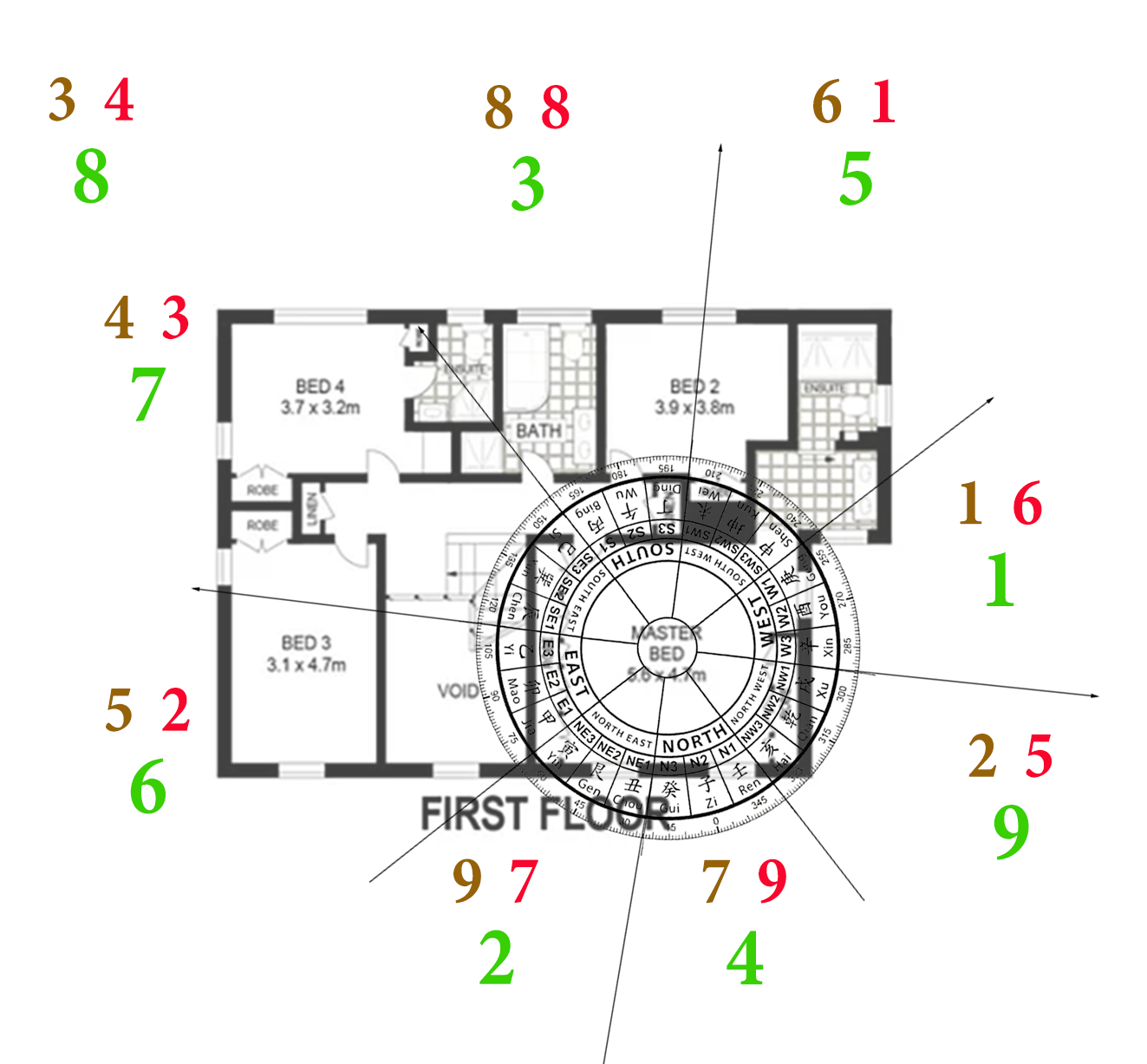
Modern geospatial technology provides an objective, highly reliable methodology for Feng Shui alignment. High-resolution satellite imagery and official cadastral surveys (such as the GeoInfo Map and survey maps provided by the Hong Kong Lands Department) are calibrated directly to Geographic True North with sub-degree accuracy, perfectly fulfilling the original premise of classical Feng Shui.
-
Extract Official Cadastral or High-Resolution Satellite Maps
Locate the target building lot, utilize mapping geometry tools to draw the building's primary structural baseline, and determine the exact macro-facing degree of the overall structure relative to True North.
-
Overlay Floor Plans to Analyze Individual Units
High-rise residential layouts are multifaceted; overlay the individual unit's architectural floor plan onto the building's True North coordinate system to establish the precise orientation of its primary Qi-intake sectors (main door, primary facade windows, balconies).
-
Conduct Outdoor Cross-Verification
If utilizing a physical Luopan on-site, take readings in an open outdoor area away from underground car parks, electrical substations, and metal railings to capture an uncorrupted magnetic reading, cross-referencing it with local magnetic declination.
Qi Formula Analysis and Indoor Micro-Magnetic Field Optimization
Once the macro-facing direction of the building and unit is accurately established via True North satellite mapping, various classical Qi distribution methods can be applied:
| Feng Shui School | Angular Tolerance | Consequences of Measurement Error |
|---|---|---|
| Eight Mansions (Ba Zhai) | Broad (45° per Trigram) | High tolerance; a few degrees of error rarely alter the East/West Group classification. |
| Flying Stars (Xuan Kong) | Strict (15° per Mountain) | Extremely low tolerance; a shift of merely 3 to 5 degrees can trigger a "Substitute Star" (Jian Xiang) chart, fundamentally altering the entire star chart pattern. |
Once a building's macro-orientation (such as Sitting North, Facing South / Zi Shan Wu Xiang) is locked via True North, indoor compass fluctuations should not alter the overarching natal chart. However, localized indoor magnetic anomalies should not be ignored: while localized rebar turbulence and electrical fields do not change the macro-alignment, they can disturb human bio-magnetic fields and sleep quality. Therefore, indoor measurements should serve as micro-environmental scans to reposition beds and optimize functional layouts away from high-interference zones.
Frequently Asked Questions (FAQ)
Q1: Are smartphone compasses completely unreliable for Feng Shui audits?
When used in open outdoor spaces after a proper "figure-8" calibration, smartphone compasses can provide general reference directions. Indoors, however, Hall effect sensors are heavily compromised by concrete rebar and electromagnetic fields, making them unsuitable as the sole basis for fine-degree alignment.
Q2: Does a satellite-derived facing angle need manual declination adjustments?
If you practice modern geospatial alignment based on celestial True North, apply the True North degree directly to the 24 Mountains wheel. If you adhere strictly to traditional lineages that mandate pure local geomagnetic interaction, add or subtract the local magnetic declination value to convert True North into Magnetic North.
Q3: Does the facing degree change for different floors in a high-rise building?
The primary architectural axis of the building remains identical across all levels, keeping the macro-orientation constant. However, for individual high-rise apartments, the specific distribution of external air currents, sunlight exposure, and internal partitioning means analysis should focus on each unit's dedicated Qi-intake focal points.
Bridging Ancient Wisdom with Modern Science
Determine macro-orientation through satellite mapping and optimize micro-spaces via on-site diagnostics to achieve true harmony between architecture and environment.
Leave a Comment