
Use True North for Feng Shui Survey
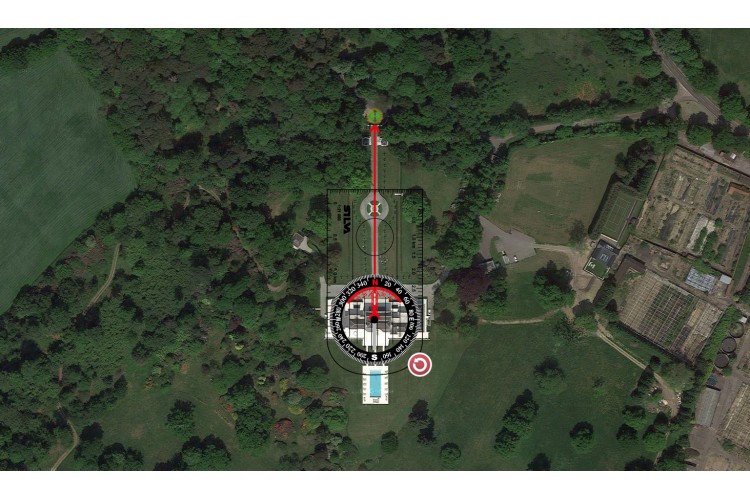
As Feng Shui enters an era of scientific inquiry into the underlying forces of nature, several points of contention have emerged—some quite intense, others relatively mild. Mr. Ip believes that one of the primary issues lies in the measurement accuracy of the Luopan (Feng Shui compass), as its readings are based on a standard central compass that points toward Magnetic North. Because the Earth's magnetic field is constantly shifting, the direction indicated by a compass changes accordingly. In the past, the magnetic declination in China was relatively stable at around 5%. However, if you use a Luopan in Vancouver, the difference between Magnetic North and True North is nearly 12%. This has created a natural divide between the traditional and modern schools of Feng Shui: if a practitioner relies solely on compass readings, can the results still be considered accurate?
The Scientific Transformation of Feng Shui Measurement: The Debate Between True North and Magnetic North
Master Ip strongly advises that magnetic declination must be accounted for in calculations, explaining the reasoning: "During the Tang Dynasty, Grandmaster Yang designed the Luopan based on the True North of that time. Later, during the Song Dynasty, Grandmaster Lai discovered discrepancies when comparing his observations with Master Yang’s results. At the time, he couldn't explain the cause, as he was unaware of the existence of magnetic declination. Nevertheless, he adjusted the Luopan by adding an extra ring and changing the division angles from 15 degrees to 7.5 degrees. Therefore, Feng Shui was originally based on True North, not Magnetic North." However, since Master Lai's time, the Luopan has remained unchanged. To elevate Feng Shui to new heights, discussing this issue is vital, as even a 1% margin of error can lead to vastly different outcomes.

Understanding Magnetic Declination: A Dynamic Mapping Challenge
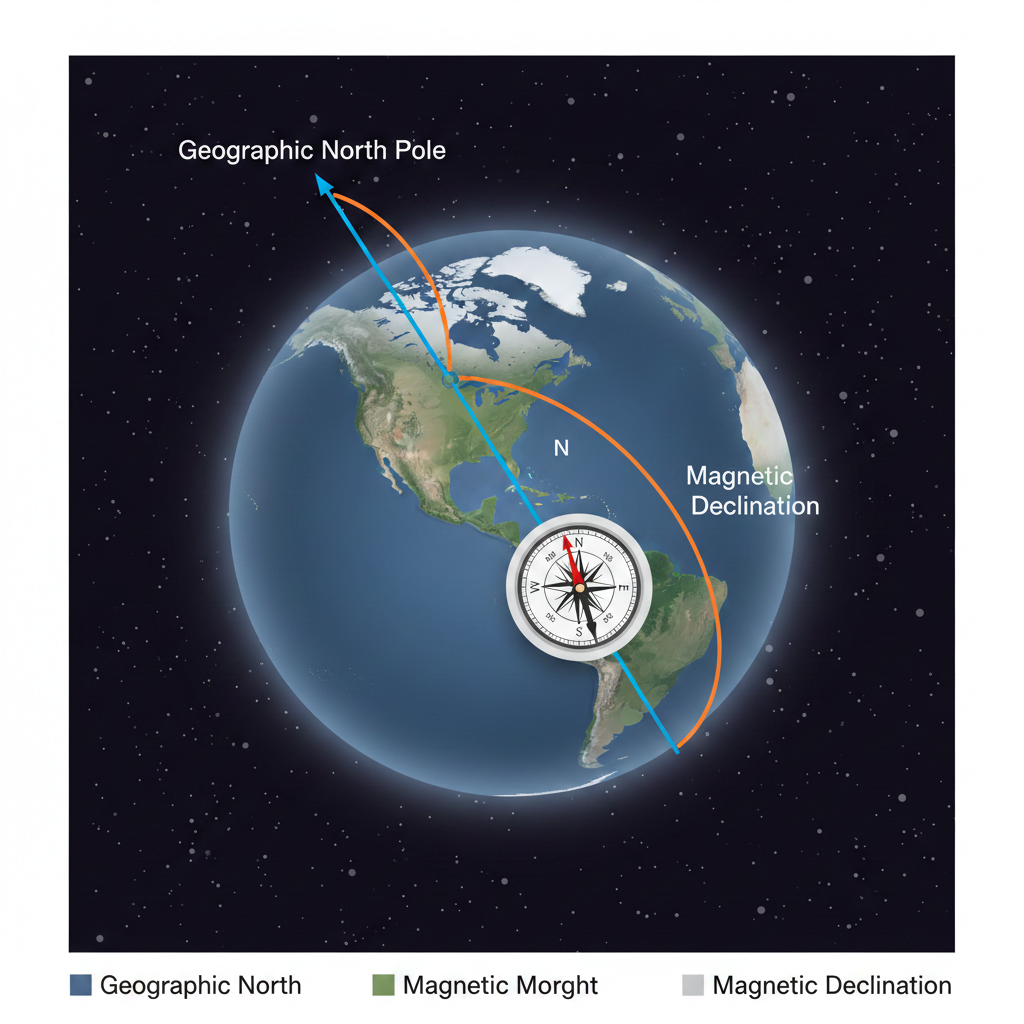
Magnetic Declination refers to the angle between Geographic True North (the point where the Earth's axis of rotation meets the surface) and Magnetic North (the direction a compass needle points in response to the magnetic field). This angle is not a fixed value; it varies depending on geographic location and changes over time. In Feng Shui placement, a deviation of just a few degrees can cause the "Fen Jin" (alignment lines) to fall into the wrong hexagrams, thereby affecting the judgment of the entire energy field.
Compass Errors: Environmental Interference and Limitations
Beyond magnetic declination, traditional compasses face the issue of "local interference." Modern buildings are filled with steel reinforcements, electrical cables, and electronic devices, all of which generate subtle electromagnetic fields that interfere with the compass needle. If a Feng Shui practitioner relies too heavily on magnetic readings while ignoring these physical errors, the measurement results will often be skewed, potentially leading to critical errors in judgment known as "Yin-Yang discrepancies."
Modern Practice of True North Measurement: Returning to Astronomical Observation
To overcome the instability of magnetic fields, advanced modern Feng Shui practices have begun to advocate for the "True North Measurement Method." This is typically achieved through astronomical observations (such as locating the North Star) or using high-precision Global Positioning Systems (GPS) to lock onto geographic coordinates. By obtaining accurate True North data and overlaying local magnetic declination corrections, practitioners can restore the precision sought by the Song Dynasty masters, perfectly integrating ancient wisdom with modern scientific surveying.
Conclusion: Precise tools are the foundation of any metaphysical art. In today's era of advanced science, acknowledging magnetic declination and adopting more stable measurement benchmarks is not only a sign of respect for tradition but a necessary step for Feng Shui to evolve into a scientific discipline.
Leave a Comment