
Yi Jing and the Flying Star Theory
The I Ching: Cosmic Blueprint of Universal Change
The I Ching (also known as the Zhouyi) is a classic work of ancient Chinese thought, renowned as the "Book of Changes," serving as the foundational influence for great philosophers like Laozi and Confucius. Its core philosophy asserts that all things exist within an endless cycle of transformation.
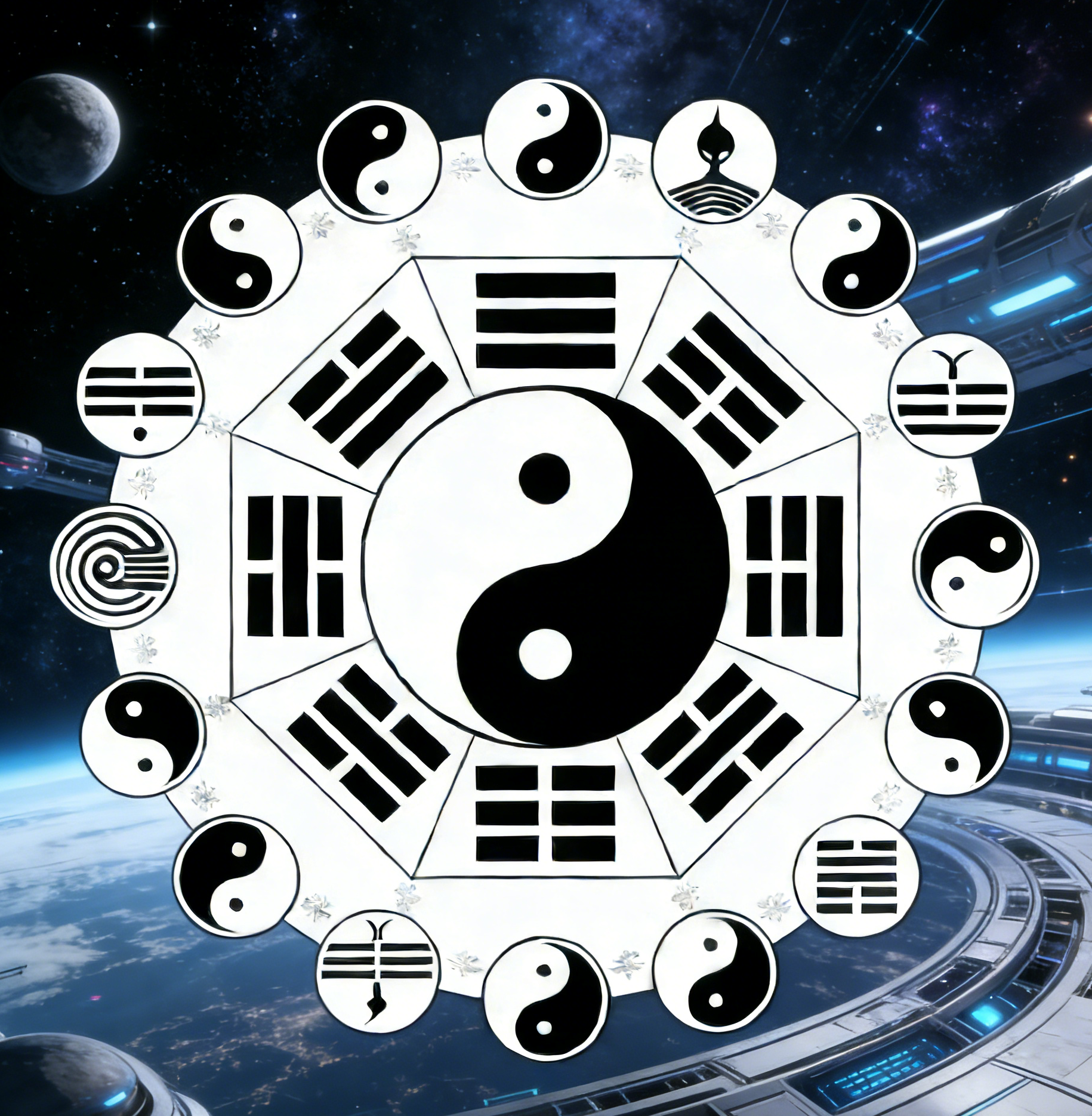
The I Ching comprises two independent dimensions: its formal structure and literary content. Its surface structure consists of the Eight Trigrams, which symbolize three fundamental states—destruction, creation, and weakening (neutralization). These three states interweave to form the Sixty-Four Hexagrams, representing all possible combinations of Yin and Yang.
This dynamic cosmology not only provides a foundation for philosophy but has also become a scientific tool for prediction and planning in later generations. From celestial movements to human affairs, the I Ching teaches the wisdom of adapting to circumstances and seizing opportunities for transformation.
From Divination Tool to Life Strategy
Originally, the I Ching served as a divination tool to predict present conditions and future outcomes; later it evolved into a book of wisdom from which people developed strategies, learning how to influence specific situations for personal benefit and improve their destiny. This required the invention of tools to identify and measure the flow of Qi.
This evolution from "observing the way of heaven" to "acting according to heaven's principles" embodies the practical spirit of Chinese wisdom. The I Ching is no longer merely a book of prophecy but a practical guide teaching how to find opportunities and resolve crises amidst constant change.
"Heaven's movement is vigorous; thus, the noble person strives relentlessly" — I Ching, Qian Hexagram, teaching people to uphold principles and take proactive action in an unpredictable world.
Flying Star Feng Shui: Modern Application of I Ching Mathematics
One Feng Shui school—Flying Star Feng Shui—focuses on the real-time environment within buildings (such as homes or offices). Its theory derives from the mathematical structure of the I Ching and further deepens the interconnectedness of Qi.
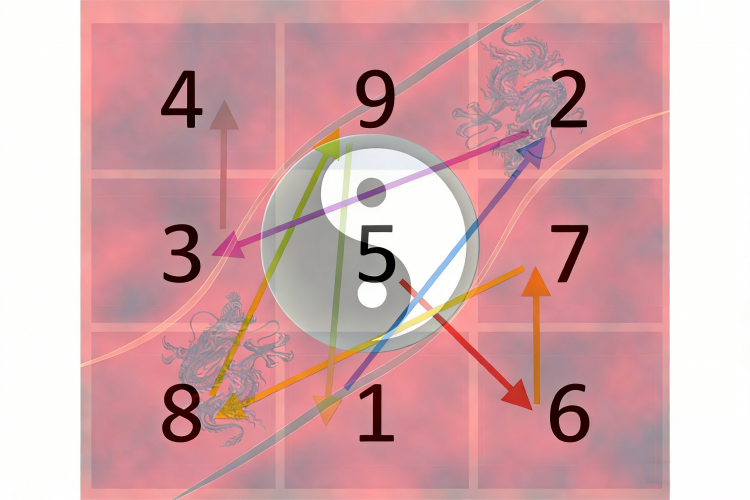
Flying Star introduces the Five Elements classification of Qi (Wu Xing): Fire, Water, Wood, Metal, Earth, assigning each element a color: red, black, green, white, yellow. The positioning of these elements is calculated using the Luo Shu, a 3x3 magic square where each cell contains numbers 1 through 9, and the sum of numbers in any row, column, or diagonal equals 15.
Legend holds that the Luo Shu was originally discovered on the shell of a giant turtle, making it a auspicious symbol from nature itself. This "heaven-granted diagram" became the foundational tool for later Feng Shui masters to analyze spatial Qi fields, concretizing abstract cosmic principles into operable spatial layouts.
Luo Shu Magic Square: Visualizing Static Cosmic Qi Fields
This magic square serves as a visual aid to depict static cosmic Qi fields, dividing homes or offices into nine sectors, each corresponding to different Qi influences. The chart can be easily overlaid onto floor plans of the space being studied.
In the Luo Shu, the center is 5, representing Earth element and balance; the surrounding eight palaces are sequentially arranged, forming the magic square's unique property where "three horizontal, three vertical, and three diagonal lines all sum to 15." This perfect mathematical structure is regarded as the most precise two-dimensional projection of cosmic Qi fields.
Feng Shui practitioners overlay actual building floor plans with the Luo Shu magic square to immediately identify each sector's Five Elements attributes and energy strength, laying the foundation for subsequent Flying Star analysis.
The Dynamic Revolution of Flying Stars: Tracking Qi Through Time and Space
Flying Star Feng Shui (named for its symbolic "nine stars") evolves the Luo Shu into a similar nine-palace grid, but the numbers are not static—they continuously change positions. The transformation cycle spans twenty years as a major period, even subdivided into yearly and hourly cycles, though most Feng Shui masters prefer annual calculations.
As the "stars" rotate positions, the numbers, elements, and color combinations within each space also change, representing different Qi distributions that require corresponding Feng Shui adjustments. This "dynamic Qi field analysis" is Flying Star Feng Shui's most distinctive feature compared to other schools.
Twenty-Year Periods and Annual Adjustments
The Flying Star system divides into nine major periods of 20 years each. We recently completed Period 8 (2004-2023) and have now entered Period 9. Each period has its prosperity star, and different star combinations in various palaces produce auspicious or inauspicious effects.
Beyond major periods, there are also annual and monthly Flying Stars. For example, in 2024 (Jia Chen Year), the 2 Black Disease Star flies to the far west, requiring special attention to health issues in that sector; the 5 Yellow Disaster Star flies to the northeast, where that direction should remain quiet and undisturbed.
Feng Shui masters employ three-layer analysis—"natal stars, mountain-facing stars, and time stars"—to precisely grasp a building's energy codes across different times and spaces. Through Five Elements productive-destructive principles, they activate auspicious stars and remedy malevolent ones using colors, materials, water features, and other methods.
The Core Value of Flying Star Feng Shui: Time-Managed Spatial Energy
Flying Star Feng Shui's greatest contribution lies in elevating static spatial analysis to dynamic time management. Homes are no longer fixed energy fields but living systems that evolve with cosmic cycles.
This philosophy of "heaven-human unity and time-space synchronization" both inherits the transformative philosophy of the I Ching and demonstrates ancient China's profound insight into universal laws. Through periodic adjustments, homeowners can maximize beneficial stars of the current period, avoid malevolent star interference, and achieve "harmonious resonance and mutual prosperity between people and environment."
Leave a Comment