
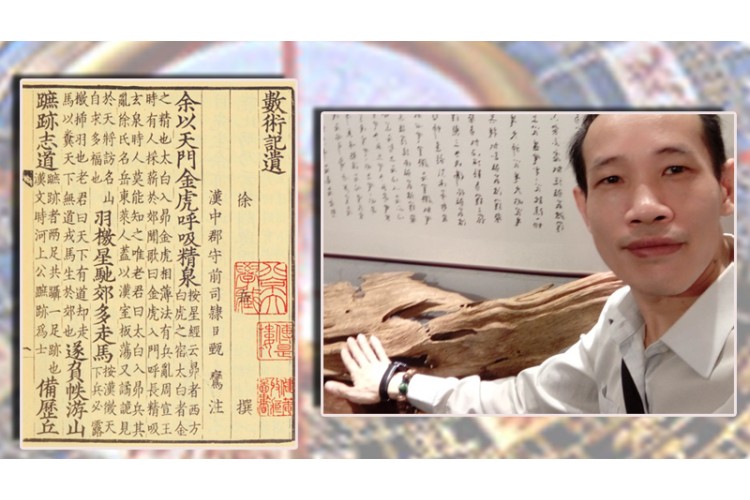
I was recently honoured to be selected by the Hong Kong metaphysics magazine qloving as one of the “Top Ten Metaphysics Practitioners in Hong Kong.” I truly feel unworthy of the title. Nevertheless, when it comes to metaphysics, I would like to share some of my thoughts with readers. The term Xuanxue “玄學” originally referred specifically to a philosophical trend during the Wei and Jin dynasties in traditional Chinese culture and history. It was not until modern times that the term was extended to refer broadly to all forms of Chinese divination arts, such as feng shui and destiny analysis, as well as Taoist ritual practices, certain Buddhist tantric techniques, and various forms of astrology, spiritual cultivation, remote viewing, mediumship, energy healing and mysticism from India and the West.
Today, all supernatural phenomena that science has been unable to explain are placed under the broad category of metaphysics. There is even a saying that “the end of science is metaphysics.” If metaphysics is understood in this broad sense, I certainly would not dare call myself a metaphysics master. At most, I am simply a practitioner working in one small branch of metaphysics: more accurately, a feng shui and fortune-telling practitioner.
1. Traditional Metaphysics: Divination Arts (Metaphysics in the Narrow Sense)
I personally prefer to follow the definition of the “Divination Arts” category in the “Four Treasuries” series, Siku Quanshu. Its general catalogue states:
“After consulting ancient texts and examining more recent methods, they may be divided into three categories: the assessment of dwellings and tombs; divination; and books on destiny and physiognomy. When brought together as one, they are known as yin-yang and the Five Elements.”
Therefore, I believe that the core of traditional Chinese divination arts consists of three major areas: feng shui, divination and fortune-telling. This is closely aligned with the development of modern BaZi destiny analysis. Both use the structural model of “qi—yin-yang—the Five Elements” to explore the patterns governing life and the universe.
2. The Perspective of the Modern “Five Arts”
The “Five Arts” commonly mentioned in modern metaphysics circles—Mountain (Immortality), Medicine, Destiny, Divination and Physiognomy—were first systematized by Japanese scholars. This classification places Taoist spiritual cultivation, represented by “Mountain,” first, followed by traditional Chinese medicine, and then fortune-telling, divination, feng shui and face reading. This classification is highly valuable as a reference because it clearly identifies the I Ching as the source of all five arts.
As the General Catalogue of the Siku Quanshu states: “The rise of the divination arts … does not go beyond yin-yang and the Five Elements, along with generation, restriction, control and transformation; in reality, they are all branches of the I Ching.” Although Taoism and traditional Chinese medicine both originated from the study of the I Ching, in modern society, traditional Chinese medicine has become a highly specialized field, and few Taoist ritual masters or practitioners of the divination arts can master all of these areas simultaneously.
3. My Journey into Metaphysics: From Family Heritage to Study Abroad
My passion for Chinese culture began with my Hakka heritage. When I was in junior secondary school, my uncle was compiling our family genealogy. I discovered that one of my ancestors was actually a renowned Taoist priest during the reign of Emperor Xuanzong of the Tang dynasty: Ye Fashan. According to legend, he once used magic to lead Emperor Xuanzong of Tang on a journey to the Moon Palace. This family connection planted the seed in my heart to explore traditional Chinese culture. By the time I was in secondary school, I had already begun studying the I Ching and Zi Wei Dou Shu. On one occasion, the renowned master Cai Bo Li visited my home to assess its feng shui. Curious to learn more, I followed him throughout the process and asked questions. This experience further strengthened my determination to study feng shui.
During university, I chose to study Chinese at the Department of Chinese Literature at National Chengchi University in Taiwan. Zhinan Temple, a famous Taoist site located in the hills behind the university, became a place where I regularly studied and learned the fundamentals of Taoist ritual practices. In my third year, I became a student of Professor Li Fengmao, who is now an Academician of Academia Sinica in Taiwan and the only academician to possess the qualifications of a Taoist ritual master. In addition to studying the Chuci or 楚辭, I also sought his deeper guidance on Taoism.
After graduating from university, I went on to pursue a master’s degree at the School of Oriental and African Studies, University of London. I subsequently worked for six years in the public libraries operated by the City of Westminster in London. While I was responsible for the Chinese Department, I had the opportunity to access a vast collection of books. Many Hong Kong metaphysics books that were not held by the British Library eventually came into my hands. The depth of my reading during those years greatly enriched my academic foundation. At that time, I also established the “I Ching Service Centre,” where I provided voluntary divination and fortune-telling services for Westerners and promoted the culture of the I Ching.
Later, a friend and I established a real estate agency, giving me the opportunity to work with various luxury properties in the United Kingdom. This provided a major practical platform for applying my feng shui knowledge. After returning to Hong Kong, through a twist of fate, I was assigned to Macau, where I organized feng shui and bazi courses attended by several hundred students. Throughout this period, I continued to exchange ideas with people from all walks of life in an amateur capacity.
4. Combining Technology with Tradition: The Evolution of Modern Metaphysics
After returning to Hong Kong to settle permanently in 2014, I established my current official website in 2016. I hoped to use internet technology to overcome geographical limitations and help people around the world. In addition to providing feng shui consultations, I also combined the crystals and gemstones I developed a passion for during my time in London with the theory of the Five Elements to create crystal accessories designed to enhance good fortune.
I firmly believe that metaphysics must not be abandoned by the times; it must continue to evolve alongside society. Recently, I developed the latest AI “BaZi Charting” tool, which uses artificial intelligence to provide free BaZi calculations for everyone. I believe that many phenomena that modern science still finds difficult to explain will eventually be verified. I continue to learn and develop along the path of metaphysics, dedicated to transforming ancient wisdom into a force that drives modern civilization forward.
Explore the Mysteries of Destiny Analysis with Master Feng Ip
Whether you would like to understand your personal BaZi chart or seek professional advice on feng shui arrangements, we provide expert services that combine traditional wisdom with the precision of modern technology.
- ✦ Online feng shui assessment services
- ✦ AI intelligent BaZi chart calculation
- ✦ Customized Five Elements crystal accessories for enhancing good fortune
Leave a Comment