
What Is the Akashic Records? Its Relationship with Buddhist and Taoist Thought
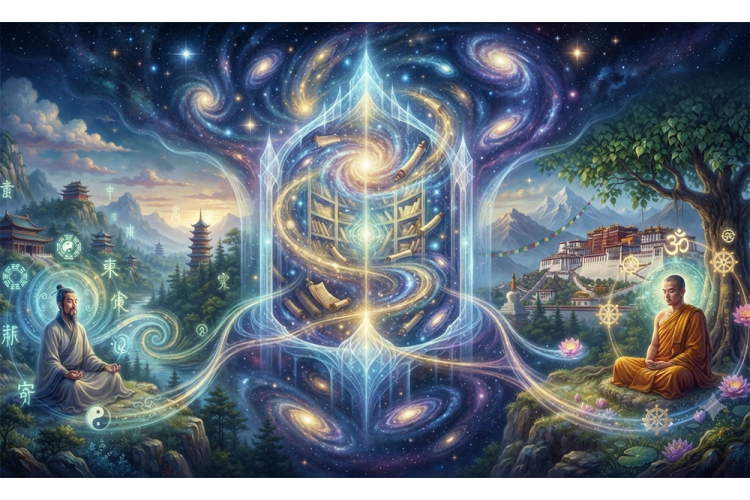
The Akashic Records is an important spiritual concept in modern Western New Age movements. It is usually described as a cosmic field of information or an “energy database” that records every thought, action, and experience of all souls across the past, present, and future. Although this concept has become widely known in contemporary spiritual circles, tracing its intellectual origins reveals deep and complex connections with nineteenth-century Theosophy, Indian philosophy, and even Buddhist and Taoist thought.
The Intellectual Origins of the Akashic Records
The word Akasha comes from Sanskrit, originally meaning “void,” “ether,” or “space.” This concept was introduced into Western thought in the nineteenth century through Theosophy. The Theosophical Society was founded in the United States in 1875 by Helena Blavatsky and Henry Steel Olcott, with the aim of integrating Western Neoplatonism with Eastern religious traditions such as Hinduism and Buddhism. Its famous motto, “There is no religion higher than truth,” had a profound influence on later Western esotericism and the New Age movement.
Henry Steel Olcott, one of the founders of the Theosophical Society, was also the first prominent Western convert to Buddhism. He played an important role in the revival of Buddhism in Sri Lanka. In his book Buddhist Catechism (1881), he wrote that “Buddha taught two things are uncaused, viz. Ākāsha and Nirvāna; everything has come out of Ākāsha in obedience to a law of motion inherent in it, and passes away.” Here, Ākāsha became one of the philosophical roots of the later Akashic Records concept, while Nirvāna represents the ultimate state of liberation.
The Development of Theosophical Thought
Later, A. P. Sinnett, a member of the Theosophical Society, further developed this idea in Esoteric Buddhism (1883), drawing on Olcott’s views and gradually reframing Akasha as a foundational medium underlying all phenomena in the universe. Blavatsky described it as a kind of life force and referred to “indestructible tablets of the astral light” that recorded the past and future of human thought and action. By the time C. W. Leadbeater published Clairvoyance (1899), the term “Akashic Records” was explicitly used for the first time, with the claim that clairvoyants could read these records and even describe Atlantis and future civilizations. At this point, the concept became more fully formed.
Later still, Alice A. Bailey described the Akashic Records in The Light of the Soul (1927) as a vast “cosmic film” recording the experiences and thought-forms of all life. She was also one of the earliest thinkers to use the term “New Age,” making the Akashic Records an important foundation for modern spiritual movements. Over time, the Akashic Records came to be seen as a system through which individuals could explore karmic causes and effects, heal trauma, and receive spiritual guidance through meditation, channeling, or prayer.
Akashic Records and Modern Spiritual Practice

In contemporary practice, for example in the teaching system passed down by Linda Howe, emphasis is placed on the idea that “energy is greater than information.” In this view, the essence of reading the Akashic Records is not to obtain specific answers, but to perceive the flow of energy and guide personal awareness and transformation. This perspective suggests that the Akashic Records are not simply an “information bank,” but rather a dynamic field of consciousness.
The Contemporary Understanding of the Akashic Records It is regarded as a system for understanding past-life karma, healing the mind, and obtaining guidance for life. In practice, the focus is often not only on “what is known,” but on “what is felt” and “how transformation happens.”
Corresponding Concepts in Buddhism
From a Buddhist perspective, the concept of the Akashic Records can be compared with “emptiness” and “suchness” (dharmata). In Buddhism, “omniscience” (samyak-saṃbuddha) refers to the Buddha’s complete awakening to the true nature of all phenomena, not through limited analytical thought, but through direct realization of the unchanging reality of suchness. This form of knowing does not come from reading external data, but from profound realization of the nature of the universe itself.
In addition, Buddhist meditation systems such as the “four dhyānas and eight absorptions” and the “five supernormal knowledges” offer another interpretive framework. Through deep meditative absorption, practitioners may develop abilities such as the knowledge of former lives, telepathy, and divine vision, enabling them to observe past lives, the minds of others, and the cycle of birth and death. These abilities do not depend on an external database, but arise when consciousness becomes purified and highly concentrated, allowing direct contact with deeper layers of the dharma realm.
It is also worth noting that in Buddhism, the “space element” (ākāśa-dhātu) refers to a non-obstructive spatial reality, functioning as the interval and condition that allows all things to exist in relation to one another. This “emptiness” is not nihilism, but a foundational structure that contains and pervades everything. From this angle, the universe-wide informational field described by the Akashic Records can be seen as a modern interpretation of emptiness, although its reduction of emptiness into a “recording library” departs from the philosophical depth of early Buddhism.
The Taoist Interpretation
From the perspective of Taoist thought, the Tao is regarded as the source and governing principle of all things in the universe. The Tao Te Ching says: “The Tao gives birth to One; One gives birth to Two; Two gives birth to Three; Three gives birth to the ten thousand things.” The Tao is not a concrete object, but an invisible, formless, and all-encompassing ultimate reality. In modern terms, the Tao can be understood as the “underlying code” of cosmic operation.
Master Feng Ip suggests that the evolution of the universe operates like a constantly running system: life information is written into DNA, while the evolution of consciousness is recorded in some higher-dimensional “information field.” If the universe is compared to a giant computer, then the Akashic Records would be the storage system behind it, preserving the history and possibilities of all existence. From this perspective, the Tao itself can be seen as the essence of the Akashic Records, while all things in the world are the outputs of its ongoing operation.
Science and Future Possibilities
That said, it must be emphasized that science has not yet verified the existence of such a cosmic information field. Although theories such as dark matter and quantum fields offer some imaginative possibilities, there is still no direct evidence to support this view. Even so, perspectives from different cultures and traditions—including Buddhist ideas of reincarnation, mediumistic cases, near-death experiences, and various spiritual practices—seem, at different levels, to point toward the existence of some kind of information storage mechanism.
In summary, the Akashic Records is not a concept from a single source, but rather a product of Western Theosophy’s reinterpretation of Eastern philosophy, especially Buddhism and Hinduism. Its core ideas correspond in some ways to Buddhist emptiness, karma, and supernormal abilities, as well as to the Taoist concept of the Tao and cosmological ontology. However, Buddhist and Taoist thought emphasize the realization of ultimate reality rather than the reading of information; in that sense, they differ fundamentally in both spiritual purpose and philosophical depth.
In the future, as science continues to explore the nature of the universe—especially dark matter and the structure of information—humanity may one day gain a more rigorous understanding of these ancient and mysterious concepts. At that point, whether the Akashic Records is merely a symbolic metaphor or a real cosmic mechanism may no longer be only a matter of mysticism, but something science can also begin to approach.
Leave a Comment