
Unlocking the Mysteries of Bazi: How Ancient Timekeeping and 15 Minutes Can Shape a Lifetime
In modern life, we can easily check the time and lunar solar terms down to the minute using our phones or web browsers. But how did people record time in the technologically underdeveloped ancient past, and how did these time records profoundly influence a person's "Bazi birth chart"? Let's explore the mysteries of ancient timekeeping from the perspectives of literature, history, and destiny analysis.
1. Starting from Su Shi's Poem: "A Spring Night is Worth a Thousand Pieces of Gold"
The great Northern Song Dynasty litterateur Su Shi 蘇軾 wrote the famous lines in his poem Spring Night: "A spring night is worth a thousand pieces of gold, flowers have a subtle fragrance and the moon has its shadows." Originally, the poem describes how the scenery of a spring night is serene and time is extremely precious, reminding people to cherish fleeting moments.
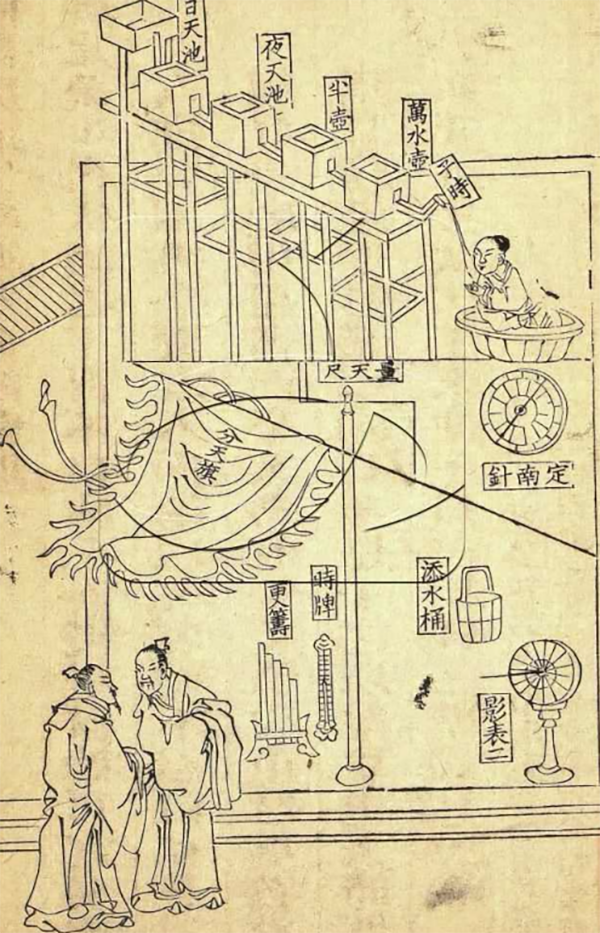
However, the "one ke" (quarter/interval) in this poem was not a figurative number in ancient timekeeping. Although ancient people mainly used "shichen" (two-hour earthly branch periods) to tell time, they used "ke" as a smaller unit to grasp time more precisely. People used sundials to observe shadow lengths on sunny days or clepsydras (water clocks) to read the graduations on the leakage arrow. Therefore, "one ke" in ancient times was not merely a literary sigh, but a traceable measurement of weight and length.
2. Ancient Timekeeping Methods: Drum Towers, Five Watches, and Night-Patrol Ruins
In ancient towns, the Drum Tower was the timekeeping center of the entire city. People used the Drum Tower to broadcast time, conveying the message of "morning bells and evening drums": at dusk during the Xushi hour (approx. 19:00), the bell was rung to start the night watch, symbolizing the beginning of nightlife; at dawn during the Yinshi hour (05:00), the drum was beaten to conclude it.
At night, time announcements shifted to the "watches" (geng). The night was divided into five watches, each lasting about two hours:
- First Watch (Xushi): 19:00 - 21:00
- Second Watch (Haishi): 21:00 - 23:00
- Third Watch (Zishi): 23:00 - 01:00 (commonly known as "the deep of night")
- Fourth Watch (Choushi): 01:00 - 03:00
- Fifth Watch (Yinshi): 03:00 - 05:00
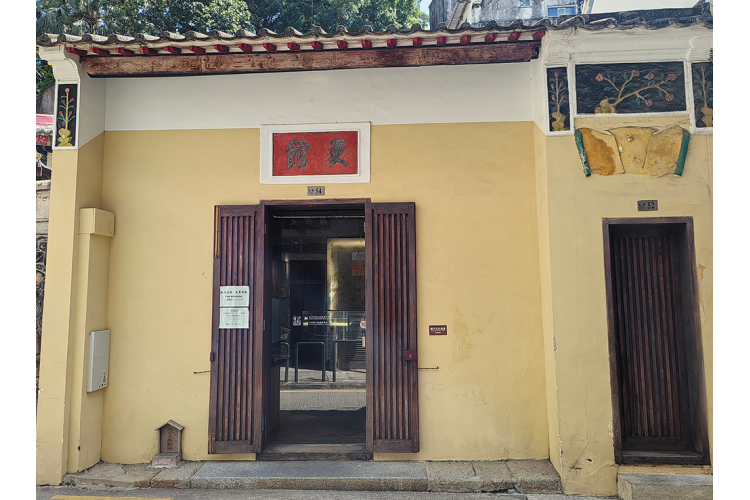
To maintain public order and prevent fires, ancient times established the night-watch system. Watchmen patrolled the streets and struck time-beating tubes, a culture that extended into modern times. For instance, in Macau, the Shalaitou Watchhouse historical site is still preserved today. Built in the 1940s, this watchhouse is the sole surviving watchhouse architecture in the Pearl River Delta region, witnessing the history of watchmen who patrolled, announced time, reported rising tides, and even assisted in firefighting.
3. Qing Dynasty Time Adjustments: 15-Minute Quarters and "Three Quarters Past Wu"
Ancient timekeeping units adjusted with dynastic changes. Before the early Qing Dynasty, a day was divided into 100 ke, with each ke lasting about 14.4 minutes. By the Qing Dynasty, to align with Western calendar methods and simplify calculations, the system was changed to 96 ke per day. This made a single shichen cleanly divisible into 8 ke (4 initial and 4 primary parts), and "one ke" officially integrated with modern standards at exactly 15 minutes.
Commonly heard terms are closely related to this:
- Deep of the night (三更半夜): Refers to the late-night slot of the third watch (Zishi).
- Three quarters past Wu (午時三刻): Refers to the third quarter of the initial Wu period, approximately 11:45 AM in modern time. In ancient times, this was considered the peak of Yang energy during the day and was frequently chosen by officials to execute criminal sentences, intending to suppress the negative Yin energy of the condemned.
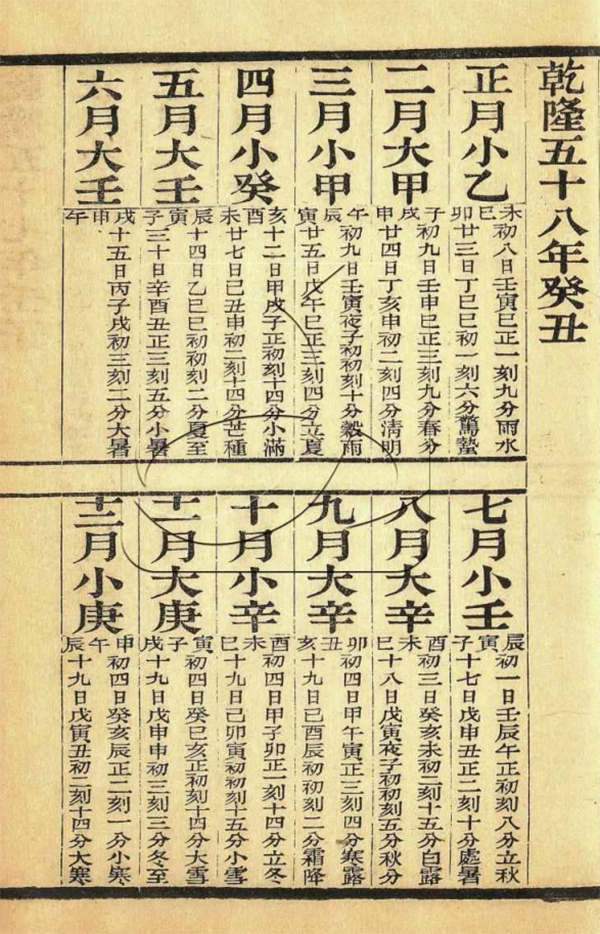
Officially published Qing dynasty almanacs, such as the Imperial Perpetual Calendar (御定萬年書), recorded time with extreme precision. For example, records from the twelfth month of the 58th year of Emperor Qianlong would precisely state "Wuyin day, Chou period, initial part, second quarter, 14th minute, Major Cold solar term." This practice of subdividing time into initial/primary, quarters, and minutes provided an extremely precise foundation for destiny calculations.
4. Evolution of Dynastic Solar Term Announcements and Perpetual Calendars
China is one of the earliest countries in the world to invent calendars, with almanacs recorded in oracle bone scripts over three thousand years ago. During the Tang Dynasty, to prevent private printing by commoners, the emperor ordered that almanacs must be officially reviewed and printed by the government, hence earning the name "Imperial Calendar (Huangli)".
The Imperial Perpetual Calendar calculated by the Qing Dynasty's Bureau of Astronomy (Qingtian Jian) was extremely popular among the populace. It recorded the lengths of months, leap months, and exact moments of the twenty-four solar terms. Although older perpetual calendars sometimes contained errors due to insufficient calculation precision and were based on Beijing local time, they laid the foundation for subsequent calendar systems.
Modern-published perpetual calendars not only retain traditional lunar-solar correspondences and solar term times, but also integrate Gregorian calendar dates and modern hour-minute markings, adjusted according to standard time zones (such as the 120° East meridian standard time), making them much more suitable for modern daily work and destiny divination.
5. Relationship Between Time Records and Bazi Destiny Analysis
Bazi (Four Pillars) destiny analysis has a long history, centering on calculating fate through the combination of Heavenly Stems and Earthly Branches (four pillars) corresponding to the year, month, day, and hour of birth. In ancient times, people held deep concepts of stems, branches, and solar terms, naturally utilizing Bazi when recording birthdays. However, for fortune-tellers, precise solar term moments are indispensable.
Especially when calculating the "starting major luck cycle (Qi Dayun)", practitioners must consult almanacs to calculate the exact number of days between the birth date and the previous or subsequent solar term node. The method follows these rules:
- Determine Direction: Based on the polarity of the birth year stem and gender (e.g., Yang male and Yin female move forward; Yin male and Yang female move backward).
- Conversion Rule: Calculate the days to the solar term node, applying the formula "3 days equals 1 year" (meaning 1 day equals 4 months, and 1 shichen equals 10 days) to deduce the actual age at which major luck begins.
Therefore, without precise almanac verification of node-crossing moments, it is impossible to chart accurate major luck cycles.
6. Conclusion: A 15-Minute Difference Can Alter a Lifetime
Although technology is advanced today and we can check perpetual calendars via apps anytime, we still need to understand the importance of "one ke". In a Bazi chart, a mere 15-minute discrepancy can lead to entirely different outcomes.
For example: Consider someone born at 11:30 PM on February 4, 1984. According to that year's almanac, Lichun (Start of Spring) occurred at 23:19 that evening. If this child had been born at 23:10, they would still belong to the previous year's "Guihai" stem-branch; but because they were born at 23:30, after the start of spring, their birth year belongs to the "Jiazi" year. Such instances where the year pillar changes due to a matter of minutes are crucial in metaphysics. Moreover, births after 11:00 PM also involve complex controversies regarding "Early Zishi" and "Late Zishi", which is another fascinating topic worth exploring.
Want to Uncover Your Precise Birth Time and Chart Mysteries?
Master Feng Ip's AI Bazi Chart Analysis System is designed to unlock your life codes.
- ✦ AI & Perpetual Calendar Calibration
- ✦ Precise Analysis of Core Ten Gods Favorable/Unfavorable Elements
- ✦ Master Your Lifetime Fortune Fluctuations
Leave a Comment