
In this era of data and science, Bazi fortune-telling still piques the curiosity of many: Is it actually accurate? Is it mere superstition, or is there a underlying logic?
If we temporarily set aside prejudice and look at the historical origins and Five Elements philosophy of Bazi, we find that Bazi is not a collection of mysterious incantations. Rather, it is an inference system based on time that observes the laws of nature—a profound Chinese understanding of the relationship between "Heaven, Earth, and Man."
What is Bazi? The "ID Card" of Time
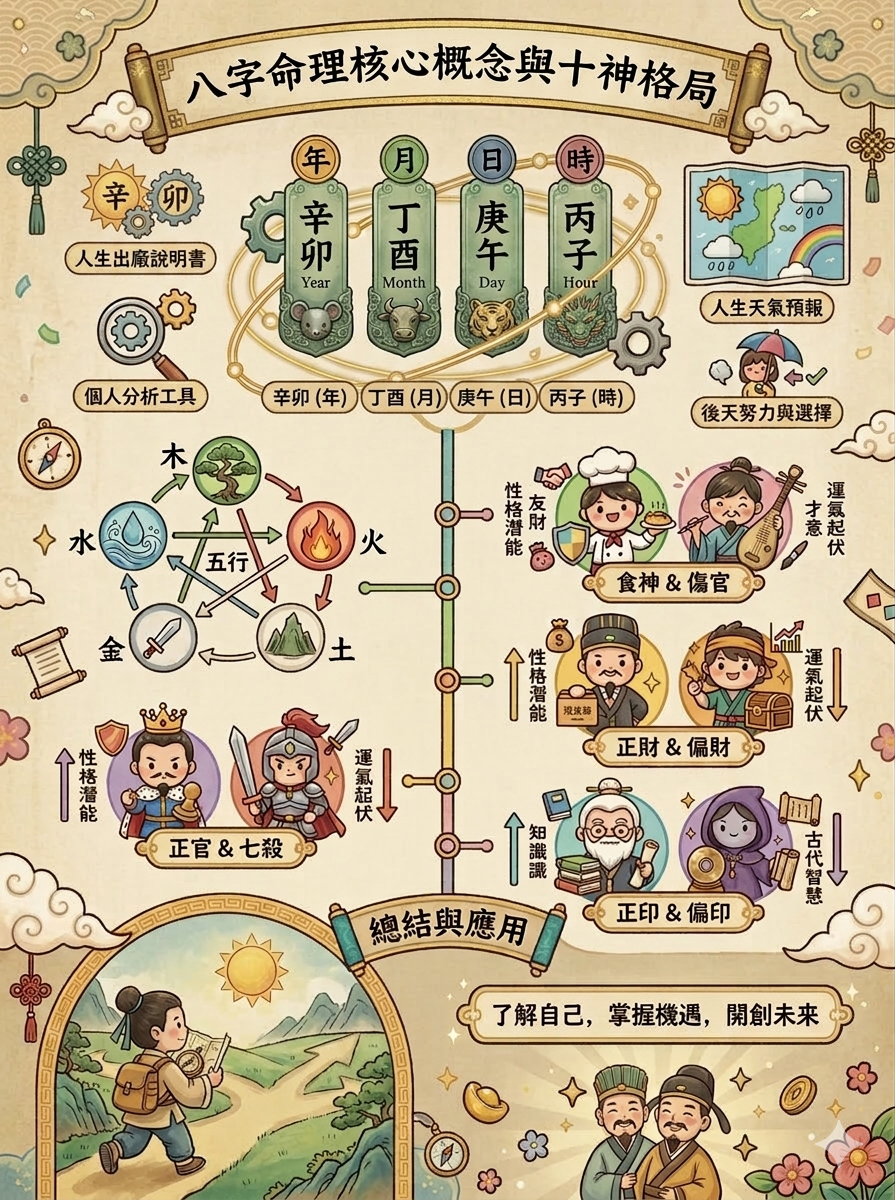
Bazi, also known as the "Four Pillars," uses the four time points of a person's birth—year, month, day, and hour—combined with the Heavenly Stems and Earthly Branches to form eight characters (Bazi) as the basis for metaphysical analysis.
There are ten Heavenly Stems: Jia, Yi, Bing, Ding, Wu, Ji, Geng, Xin, Ren, Gui; and twelve Earthly Branches: Zi, Chou, Yin, Mao, Chen, Si, Wu, Wei, Shen, You, Xu, Hai. Pairing the ten stems with the twelve branches starts from "Jia-Zi" and goes all the way to "Gui-Hai," resulting in exactly sixty combinations known as the Sexagenary Cycle (60 Jiazi). Once a cycle is complete, it restarts from Jia-Zi, like a clock that never stops, symbolizing the endless cycle of time.
Think of it like a watch: the minute hand goes around the dial for sixty minutes and returns to the starting point, but time doesn't stop—it just enters the next cycle. The 60 Jiazi functions similarly; the year, month, day, and hour all move forward on this circular track.
In the Gregorian calendar, recording time is direct—for example, March 11, 2026, at 3:11 PM. If converted to Stem-Branch format, it becomes a specific year, month, day, and hour of the cycle. In ancient times, this method appeared earlier than "month/day" numbering; for a long period, only the Stem-Branch day-counting existed, without the modern concept of months and dates.

Who Decided the First Jiazi Year? Calendar Changes and Stability
A question often arises: Who decided the very first Jiazi year? If someone later changed the starting point, wouldn't all our current Stem-Branch records be "misaligned"?
History shows that ancient calendars were indeed changed multiple times. The Xia, Shang, and Zhou dynasties were inconsistent about which month started the year (known as Jian-Yin, Jian-Chou, or Jian-Zi). During the transition between the Qin and Han dynasties, further reforms occurred. During Emperor Wu of Han's reign, the "Taichu Calendar" was promulgated, officially setting the Yin month as the start of the year. This was China's first relatively complete and scientific calendar, and it has been largely followed by subsequent generations.
This means that before the Han dynasty, the starting point of the Month Branch varied. Specifically, which Earthly Branch represented the "first month" was not consistent throughout history. Consequently, tracing the "Month Branch" for certain ancient figures often leads to controversy.
A famous example is Qu Yuan's line in *Li Sao*: "Sheti was justly in Mengzou, on Geng-Yin I descended." This describes his birth: the Great Year was in Sheti (generally considered the Yin year), Mengzou (the first month of spring), and the birthday was a Geng-Yin day. While the year and day are clear, whether the first month was Yin, Chou, or another branch remains a matter of debate due to different historical calendars.
Why is the Day Pillar the Most Reliable? The Continuity of Day Counting
From this historical context, we can see that while the Year and Month Pillars might be adjusted due to calendar reforms, the Day Pillar—the Stem-Branch of the actual birthday—has remained remarkably stable.
One of the earliest verifiable solar eclipse records is found in the *Spring and Autumn Annals* (Lü Yin Gong, 3rd Year): "In the second month, on the Ji-Si day, the sun was eclipsed." Modern astronomical calculations confirm this day corresponds to February 22, 720 BCE, and the Stem-Branch was indeed Ji-Si. This matches ancient records perfectly, showing that the Stem-Branch day-counting system has operated continuously for at least 2,700 years without interruption.
Therefore, from a metaphysical standpoint, the Stem-Branch of the birthday (Day Pillar) is the most solid and trustworthy foundation among the eight characters. Next is the Month Branch (the "Month Command"), which became stable after the Han dynasty when the year usually began with Yin.
Classic texts emphasize this: within the Bazi structure, the Day Pillar represents the person themselves (the Day Master), while the Month Command represents the environment, family background, and childhood conditions. If these two align well, the life path is usually smoother; if they conflict seriously, it often indicates internal or environmental struggles.
The Principles of Bazi: Five Elements and Balance
Once we understand which parts of the Bazi structure are most critical, we can discuss: How does Bazi actually "tell a fortune"?
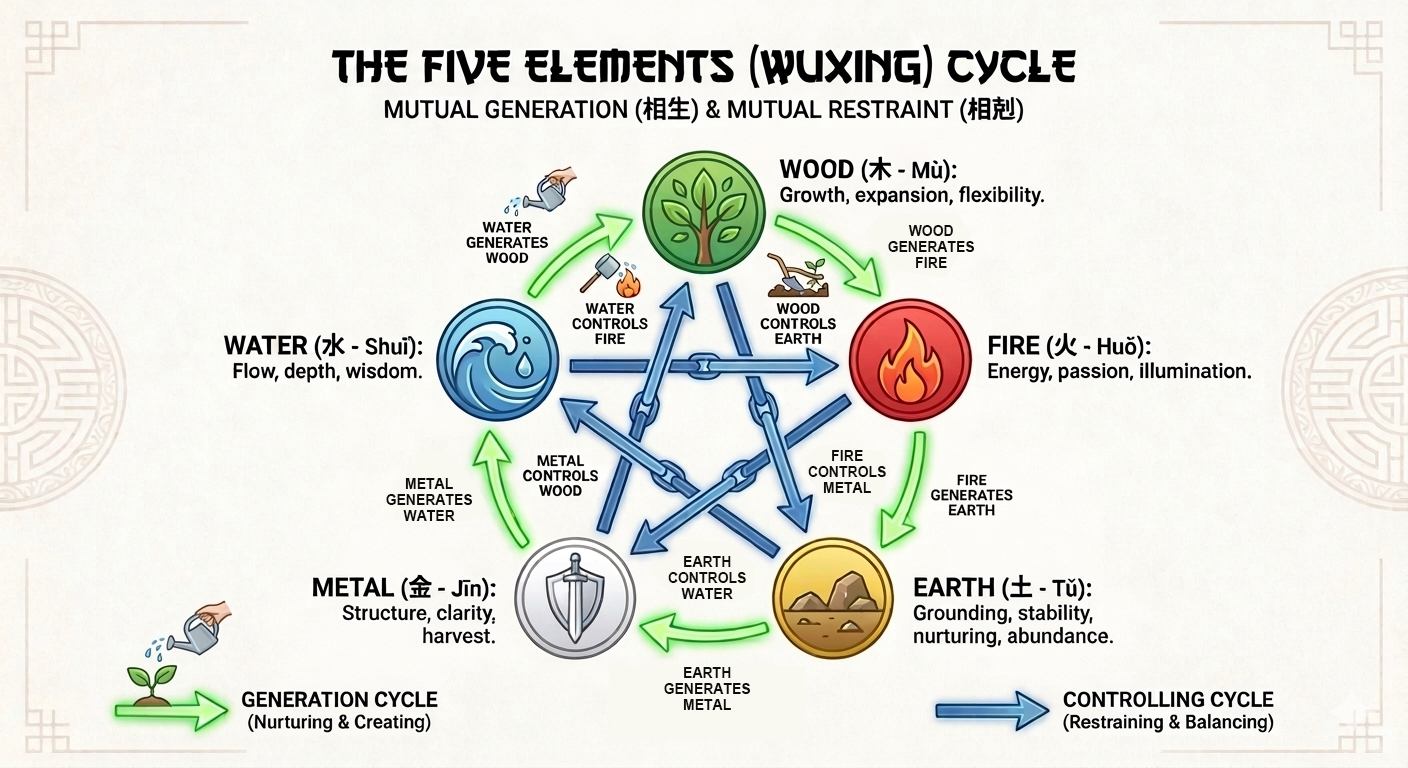
The core of Bazi theory is the Five Elements (Wu Xing). Ancients believed everything in the universe is composed of five basic elements—Metal, Wood, Water, Fire, and Earth—which operate in cycles of "generation" (creation) and "overcoming" (destruction). This cycle is not just a physical phenomenon but a symbol of personality and destiny.
For example: a volcano erupts, and hot magma cools to become land (Fire generates Earth); heavy earth contains ore veins (Earth generates Metal); rain seeps underground to form springs that nourish plants (Water generates Wood); lush trees burn to create flames (Wood generates Fire). These natural phenomena were abstracted into a concise system to explain the laws of the world.
Chinese culture emphasizes "Neutrality" and "Balance," avoiding extremes. If any element is too strong or too weak, problems arise. Thus, Bazi analysis isn't about finding the "best" chart, but rather asking: Is this person's Five Elements balanced? If not, how can they be adjusted?
An Example: Personality and Destiny
Let's illustrate with a specific Bazi fragment: Suppose someone is born on a Bing-Wu day in the month of Wu.
The Day Master is Bing Fire, symbolizing the sun—bright and intense. The Earthly Branch, Wu, is also Fire. With a Bing-Wu day and a Wu month, the overall Fire element is extremely heavy. This combination usually symbolizes an extroverted, warm, and helpful personality—someone with drive, energy, and a willingness to "burn themselves" to light the way for others.
However, that same fire, if uncontrolled, can become a flaw—a fiery temper, emotional volatility, or impulsiveness. A momentary flare-up could lead to a wrong decision. This is a concrete manifestation of Five Element imbalance.
Many agree that character determines destiny. If a person is born with such a fiery nature but remains unaware and fails to adjust, their successes and failures are already foreshadowed in their personality. Bazi simply presents these tendencies in a structured way.
In practice, a practitioner often only needs to look at the "Day Pillar + Month Command + Year Pillar" to grasp over 50% of the chart's accuracy. The remaining characters, combined with "Luck Pillars" (decadal cycles) and "Flowing Years" (annual cycles), allow for a detailed mapping of a person's life trajectory and turning points.
Why Does Bazi Sometimes Feel "Inaccurate"?
Theoretically, if the birthday can represent one's talents and destiny, shouldn't Bazi be "perfectly accurate"? In reality, many people find that while some readings resonate, others miss the mark entirely.
To understand this, we must return to an essential ancient Chinese concept: The Three Realms (Heaven, Earth, and Man). "Heavenly Timing, Earthly Advantage, and Human Harmony" are all necessary. Bazi only records the "Heavenly Timing" part. A person's life is never determined by "Heaven" alone.
Imagine two people with identical, high-potential Bazi charts. One is born in a highly developed city with abundant resources, while the other is born in a poverty-stricken, war-torn region. Even with the best Heavenly Timing, the lack of Earthly Advantage and Human Harmony will severely drag down the latter's actual life outcomes.
Conversely, even if a chart is mediocre, a person born in a stable environment with good education and support can live a very successful life through hard work and correct choices. This is where "Earth and Man" can repair "Heaven."
Today, someone born at the exact same time as a world-class billionaire would have the same Bazi, but not necessarily the same level of achievement. The difference lies in whether their country provided a stage, whether their family offered support, and whether they made key choices. These factors aren't in the Bazi chart itself, but they profoundly affect how destiny unfolds.
Bazi is "Inference," Not Absolute Fatalism
From this perspective, Bazi is more like a science of "inference." Based on Yin-Yang and the Five Elements, it deduces tendencies in talent, life rhythm, and key transitions—it is not a fixed "sentence" on one's life.
It tells us a "general direction": What environment suits you? In which fields can you excel? What patterns should you watch for in relationships, wealth, and health? Once you have this awareness, you can consciously adjust your choices and avoid repeating past mistakes.
This echoes another important concept: Heavenly Timing cannot be changed, but Earthly Advantage and Human Effort are in your hands. We cannot choose our birthday, but we can choose our city, our environment, our friends, and our attitude when facing challenges.
How to Use Bazi to Improve Your Life?
Returning to our "Bing-Wu day, Wu month" individual: Since they have an innate excess of Fire and emotions easily run high, their best path for self-cultivation is to introduce the power of Water—calmness, reflection, tolerance, and deep thinking.
Concretely, they can train themselves to "sleep on it" before major decisions, walk away when angry, and remember to "help within one's means." From a Five Elements perspective, these behaviors use Water to regulate the Fire, preventing energy from spiraling out of control and turning it into a powerful constructive force instead.
Geographically, if they live in a hot, sunny southern region, moving to a cooler northern climate might favor their mental and physical balance. This isn't about "moving because of fate," but rather a reminder: Knowing how to go with the flow adds points to your destiny.
Conclusion: Bazi Isn't Actually Mysterious
If we look back at the beginning: Bazi is a tool for recording time using Stems and Branches, a product of ancient observations of celestial and natural rhythms. The Five Elements are a philosophical framework for understanding all things. Together, they form a system that tries to answer one question: How should a person find their place between Heaven and Earth?
So, rather than asking "how good is my life," Bazi reminds you where your talents lie, where your blind spots are, and in which direction you should apply effort. Heavenly Timing is set, but Earthly Advantage and Human Harmony are held within every choice you make today.
When we view Bazi with an open mind—as a mirror rather than a shackle—we can truly turn this ancient wisdom into a tool to live more clearly and freely.
Want to better understand your Bazi and Five Element traits?
You can start with the simplest Day Pillar and Month Command. Observe your personality and environment, then gradually explore career, relationships, and health. The more you know yourself, the easier it is to hold destiny in your own hands.
2 Comment(s)
多謝師傅的分析,很有啟發性,學習了
師傅,請教什麼是十神,上面圖片沒有解說的
八字中的十神是以日主(出生日的天干,代表本人)為中心,根據其他天干與日主五行生剋及陰陽關係定義出的十種稱謂,其實是五行關係形象化的表述;用來分析人生際遇、性格與六親關係。十神分為生我、我生、剋我、我剋、同我五類,每類再依陰陽區分正偏:
比肩:同我屬於一類的五行、陰陽相同,代表兄弟朋友、競爭、自立。
劫財:同我屬於一類的五行、陰陽不同,代表手足、朋友、奪財。
食神:我生的五行、陰陽相同,代表才華、享受、溫和、子女。
傷官:我生的五行、陰陽不同,代表技藝、叛逆、表達、子女。
正財:我剋(我控制的物質)、陰陽相同,代表妻子、財富、正當收入。
偏財:我剋、陰陽不同,代表情人、不動產、橫財。
正官:剋我(控制我的五行)、陰陽相同,代表貴人、上司、事業、紀律。
七殺:剋我、陰陽不同,代表壓力、小人、權力、魄力。
正印:生我的五行、陰陽相同,代表母親、學識、庇蔭。
偏印:生我的五行、陰陽不同,代表繼母、冷門知識、孤獨。
實際應用:十神透過五行相生相剋解釋命局,如喜用神旺則正面(如食神生財),忌神旺則負面(如七殺無制帶來壓力)。 需結合喜忌判斷具體吉凶。
Leave a Comment