
Exploring the Self-Consistency of Metaphysical Logic: Is the Split-Governance of Stems and Branches a Supreme Truth or a Logical Flaw?
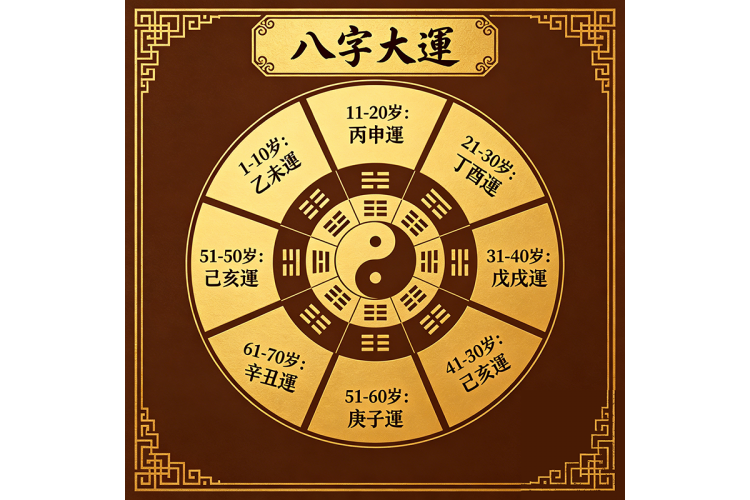
In traditional BaZi Fortune-Telling culture, debates regarding the interpretation of the BaZi Major Cycles (Da Yun) have persisted for centuries. The most common cliché claims that "the Heavenly Stem governs the first five years, while the Earthly Branch governs the subsequent five years." However, looking at the core foundational principle of BaZi—the "Trinity of Heaven, Earth, and Humanity"—does this crude method of splitting a single pillar of the Major Cycle actually hold up to the rigorous logic of metaphysical science?
When reading contemporary fortune-telling blogs or literature, we frequently encounter scholars holding strictly opposing views on this matter. The following excerpt is a textbook example:
"Speaking of whether 'Major Cycles should be analyzed pillar by pillar,' Master Lu Zhiji cited the writings of Master Zhu Queqiao in his book, yet arrived at a completely different conclusion. On page 164 of 'A Course in BaZi Fortune-Telling' (Volume 1), Master Lu references Master Zhu's perspective and writes: 'The author agrees with this viewpoint, particularly when the Major Cycle, Annual Flow (Liu Nian), and the various pillars of the natal chart interact through Clashes, Harm, Combinations, or Punishments—the Stem and Branch must be considered simultaneously. However, there is still a distinction when observing the Stem and Branch of a Major Cycle: the Heavenly Stem corresponds to the first half of the ten-year cycle (the upper five years), while the Earthly Branch corresponds to the latter half (the lower five years).' From this, it is evident that Master Lu leans closer to Master Wei Qianli's philosophy that 'the Stem rules the first five years, and the Branch rules the last five,' diverging from Master Zhu’s method of viewing the cycle as a unified pillar... Sometimes, studying BaZi requires us to let go of our obsession with absolute right or wrong."
This paragraph perfectly reflects the long-standing eclecticism of the metaphysical community—"everyone has their own merits; metaphysics is not a hard science, so there's no need to obsess over who is right." Yet, if we deduce from a pure systemic and temporal logic, we find that the "five-year split theory" harbors theoretical blind spots that fail to be self-consistent.
I. Starting with the Logical Flaw of the "Birth Hour"

BaZi Fortune-Telling is structurally composed of "Four Pillars" (Year, Month, Day, Hour). As we know, one Chinese hour (Shi Chen) represents two modern hours. If a single pillar of a Major Cycle rules ten years and can be split into a Stem governing the first five years and a Branch governing the last five, then by that same logic, should a birth hour pillar also be split into the Stem ruling the first hour and the Branch ruling the second hour?
If someone is born during a Bing-Shen (丙申) hour, does the Heavenly Stem Fire manifest exclusively in the first hour, only to abruptly mutate into the Earthly Branch Metal during the second hour? The answer is a resounding no. Whether it is the two hours of a birth pillar or the ten years of a BaZi Major Cycle, the Stems and Branches coexist and interact simultaneously as an indivisible spatio-temporal matrix. Forcing a "watermelon-slice" chronological division upon a unified unit of space-time severely violates the foundational concept of "Spatio-Temporal Oneness" in Eastern metaphysics.
II. Deconstructing the Three Main Schools of Thought on Major Cycles
Throughout the history of metaphysical development, the methodologies for handling the relationship between the Stems and Branches of Major Cycles can be broadly categorized into three schools:
| School | Core Philosophy | Logical Commentary |
|---|---|---|
| Split-Governance School (Wei Qianli, Xu Legwu) |
The Heavenly Stem rules the first five years; the Earthly Branch rules the last five. The ten-year span is split cleanly in half. | Flaw: It completely isolates the holistic nature of the Stem and Branch, serving as a simplified model for beginners. |
| Unified Pillar School (Zhu Queqiao, Ren Tieqiao) |
Ten years belong to one unified pillar; Stems and Branches are read together. The Stem represents the manifest phenomenon, while the Branch is the root foundation, emphasizing directional alignments. | Advantage: Aligning best with the "Trinity" principle, it treats the Major Cycle as an indivisible, overarching energy field. |
| Covered Stem & Trampled Branch School (The "Di Tian Sui" Sect) |
The Heavenly Stem dictates the "Omens/Manifestations" of fortune, while the Earthly Branch dictates the "Strength/Capacity" of that fortune. The two condition each other. | Advantage: It highly values the internal chemical reaction within the pillar (such as Five-Element element combats). |
III. The Internal Contradiction in Master Lu Zhiji's Argument
LOGICAL CONFLICT WARNING: The viewpoint of Master Lu Zhiji mentioned in the excerpt exposes the inherent insecurity of the "Split-Governance" theory during actual client readings. On one hand, Master Lu points out: "When the Major Cycle interacts with the Annual Flow and the Natal Chart through Clashes, Harm, Combinations, or Punishments, the Stem and Branch must be considered simultaneously;" yet on the other hand, he rigidly insists that "the Heavenly Stem corresponds to the first five years, and the Earthly Branch corresponds to the last five."
This creates an irreconcilable logical paradox: If the first five years are exclusively governed by the Heavenly Stem and the Earthly Branch has not yet taken office, what happens when an Annual Flow comes along during those first five years to clash with or punish the Major Cycle's "Earthly Branch"? Should that Branch react? If it does react (which aligns with Master Lu's instruction to "consider both simultaneously"), it proves that the Earthly Branch has been actively operative since day one of the cycle, and the fatalistic premise that the "Branch only rules the latter five years" falls completely apart.
IV. What is the True "Trinity of Heaven, Earth, and Humanity"?

In authentic BaZi Fortune-Telling, Stems and Branches are never isolated symbols; they represent a relationship of sovereign and minister, exterior and interior, essence and application. When entering a Geng-Yin (庚寅) Major Cycle, Geng Metal chops Yin Wood—the baseline climate of this entire ten-year period is a magnetic field of "Metal-Wood warfare." The accurate way to dissect a cycle is through the following dimensions:
-
The Heavenly Stem Governs the "Phenomenon" (Xiang)
It represents the external environment, triggered events, reputation, superficial appearances, and shifts in social relationships (Heavenly Omens). -
The Earthly Branch Governs the "Vehicle" (Zai)
It represents the tangible benefits of an event, the accumulation of actual wealth, physical health conditions, underlying stability, and the internal environment (Earthly Substance). -
The Ebb and Flow of Energy (Qi)
The illusion among ancient practitioners that "the latter five years favor the Earthly Branch" does not mean the Branch was asleep during the first five years. Rather, the Earthly Branch represents directional seasons and elemental structures (such as Yin-Mao-Chen forming the Eastern Wood Direction). The momentum of such seasonal environmental energy is deep, dense, and slow-moving. Its actual impact on a person's health and career foundations takes years to accumulate before noticeably erupting in the mid-to-late stages of the cycle. In metaphysics, this is known as the "Ebb and Flow of Qi," not an arbitrary, hard line cut in time.
Conclusion: Study BaZi with an Open Mind, But Maintain Flawless Logic
Rather than blindly following grandmasters, demand self-consistency and systemic fluidity from your methodology.
Some would say that "metaphysics is not a hard science; you cannot prove either side wrong, so we should abandon our obsession with correctness." While inclusive, this attitude easily misleads students into intellectual complacency. Although BaZi Fortune-Telling does not fall under the umbrella of Western natural sciences, it is an incredibly rigorous Eastern system of symbolic logic.
If the foundational axiom of the system (the Trinity) can casually collapse just because a BaZi Major Cycle arrives, the entire discipline loses its predictive and analytical value. Therefore, viewing the ten-year cycle as a single, unified pillar—where the Stem rules the external manifestation and the Branch rules the internal substance—remains the only solution that honors the true, underlying logic of BaZi.
Leave a Comment