
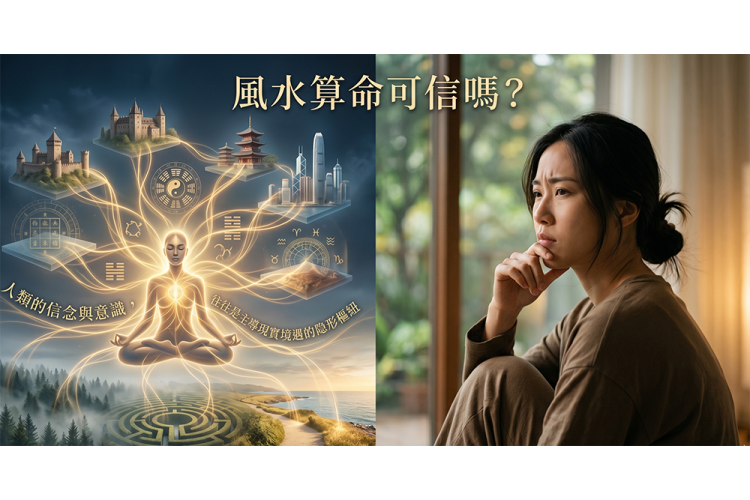
In a modern society where contemporary technology, rationalism, and empirical science are highly advanced, people still frequently seek guidance from fortune-tellers and Feng Shui masters, or look for spiritual solace and resonance through magical artifacts such as crystals and talismans. When facing enduring questions like "Is Feng Shui effective? Is fortune-telling accurate? Can crystals truly be sensed?", the most widespread and common answer circulating among the public is often: "Believe, and it exists; disbelieve, and it does not."
This common folkloric answer may superficially seem like an evasive dismissal with an agnostic color, or an excuse that slides towards idealism. However, if one examines it under the microscope of modern scholarship, they will discover that "belief"—namely, an individual's "conviction" (Belief) and "faith"—is precisely the core code that runs through human cultural construction, brain cognitive mechanisms, and the operation of cosmic energy. Metaphysics, traditional fortune-telling, body-mind-spirit, and even modern science are, in essence, all tools that humans use to attempt to understand and reconstruct the order of the world.

II. Anthropological Perspective: Faith, Integrity, and the Cultural Consensus of the Collective Unconscious
From the perspectives of anthropology and cultural history, the birth and evolution of human civilization were not built purely on a material basis, but rather on the formation of "beliefs" and "institutional consensus." In ancient times, when scattered individuals or tribes began to share common beliefs, a social consensus emerged that transcended kinship relations. This consensus, in the terminology of psychologist Carl Jung, is a form of "Collective Unconscious".
The collective unconscious carries common archetypes, symbols, and behavior patterns handed down from billions of years of human evolution. The layout of mountains, rivers, yin-yang, and the five elements in Feng Shui, and the interpretation of the Heavenly Stems, Earthly Branches, and stellar progressions in fortune-telling are actually "cultural products" and "symbol systems" that map cosmic order and human social order onto each other.
Another concrete manifestation of faith in social construction is "integrity" and "credit". A famous quote by Zengzi is recorded in the *Analects*:
“I examine myself three times daily: in planning for others, have I failed to be loyal? In intercourse with friends, have I failed to be trustworthy? In practicing the teachings, have I failed to be diligent?”
The "loyalty" and "trustworthiness" here are not merely moral norms, but are the vital elements that allowed early human civilized society to emerge. If integrity is lacking between people, social contracts cannot be established, and collective consensus will disintegrate. Similarly, learning without practice ("in practicing the teachings, have I failed to be diligent?"), in the traditional context, is also a violation of credit with the teacher and the knowledge system.
Therefore, the operation of traditional Chinese metaphysics (such as Feng Shui, fortune-telling, traditional Chinese medicine, etc.) is itself rooted in this cultural soil that heavily emphasizes "integrity" and "trust." The effectiveness of Feng Shui and fortune-telling first depends on whether an individual can reach a "contract" and connection with this millennia-old symbol system of the collective unconscious. When you firmly believe in this system, you resonate with the collective unconscious, mobilizing a massive cultural energy; if you internally resist, this cultural link will break.
III. Psychological Perspective: Introspective Awareness, Self-Efficacy, and Brain Belief Remodeling
When Zengzi talked about "examination," what does this actually mean in modern psychology? In essence, this is a process of "remodeling beliefs" and "recreating deep-level consciousness in the brain." Modern psychological cognitive science research points out that out of the massive amount of information the human brain processes every second, more than 95% is dominated by "automated thinking patterns" in the subconscious. These automated thoughts often contain many negative or limiting cognitive blind spots (such as low self-esteem, anxiety, or a sense of lack), causing individuals to repeat the same mistakes in life.
The core of "Introspection and Awareness" in psychology is identifying these automated negative or limiting thinking patterns in the brain. Through this reflection, humans can utilize rational will within consciousness to reinforce their adherence to positive beliefs, achieving the effect of using examination to remodel deep-level brain consciousness. This is called "Neuroplasticity" in neuroscience—our beliefs can substantially change the neural circuits of the brain.
Human behavior is a reflection of consciousness and belief. When an individual has sufficient confidence and conviction, their selective filtering mechanism of attention (such as the brain's Reticular Activating System, RAS) will tend to capture positive factors and opportunities in the environment, thereby driving their behavior to develop in the expected direction and leading to success. In this process, even if they encounter setbacks midway, through continuous examination and belief correction, the individual will continuously enhance their "Self-Efficacy."
People with high self-efficacy possess an extremely strong error-correcting ability and resilience against setbacks, firmly believing they have the ability to change the status quo. Human civilization has been able to overcome countless natural and man-made disasters to progress to this day precisely by relying on this core ability to remodel beliefs and enhance self-efficacy through introspection.
From this perspective, metaphysical rituals such as fortune-telling and Feng Shui often objectively play the role of a "belief catalyst." When a fortune-teller gives a positive suggestion (such as: "You will experience great fortune in your middle age") or adjusts a Feng Shui layout, the individual's inner anxiety is pacified, limiting beliefs are broken, and self-efficacy is improved. This drives changes in their own behavior, ultimately fulfilling a "turnaround in destiny." In psychology, this is also known as a "Self-Fulfilling Prophecy."

IV. Body-Mind-Spirit Perspective: The Law of Attraction, Holistic View, and Consciousness Manifestation
The recently emerged field of "Body-Mind-Spirit exploration" explains the power of belief from a more microscopic yet transcendent dimension. The core proposition of this field is that "consciousness manifests reality," which coincides perfectly with the "Law of Attraction" emphasized in contemporary New Age thought. The Law of Attraction holds that everything in the universe is essentially energy and vibrational frequencies. The thoughts and beliefs held within an individual's mind will attract energy, people, and events of the same frequency, thereby dominating one's life circumstances. The environmental adjustment of "storing wind and gathering energy" in Feng Shui can essentially be understood as a technique to adjust the energy frequency of a space so that it resonates with an individual's positive beliefs.
Furthermore, this field advocates a "Holistic View of Body and Mind," asserting that physical illness, discomfort, or predicaments in life are often "projections" or reminders of an imbalance in inner beliefs. Among the traditional Chinese "Five Arts," Traditional Chinese Medicine (TCM) is one of them, sharing the same origin as Feng Shui and fortune-telling, and both are based on the philosophy of Yin-Yang, the Five Elements, and holistic balance. TCM treats illnesses by emphasizing the regulation of the whole, mobilizing the body's own "upright Qi," and adjusting its immunity. By clearing negative beliefs out of the subconscious, the body's powerful self-healing capacity can be activated.
However, the prerequisite for all of this remains "belief." If you do not believe in TCM, it may not take effect in your body. If you are deeply resistant and skeptical toward TCM or energetic regulation, your consciousness and autonomic nervous system will remain in a state of tension and defense, resisting these adjustments on both physiological and conscious levels, and the illness naturally will not be cured.
Understanding this principle makes it clear that Feng Shui and fortune-telling operate on the exact same mechanism. Feng Shui masters,命理 (destiny) scholars, and TCM practitioners are no different in their roles; they all diagnose and prescribe for you according to traditional methods and symbol systems. But if there is resistance, skepticism, or disbelief in your inner consciousness, then this path of energy transmission and the contract of trust are blocked, and the effect will inevitably fail to meet expectations or even be entirely useless.
V. Conclusion: The Intersection of Science and Metaphysics

In summary, whether it is metaphysics, science, or the shared underlying logic of all human culture, it ultimately comes down to a single word: "Belief." The development of science did not come out of nowhere; when facing unknown phenomena, scientists often go through countless failed experiments, holding onto a powerful belief and hypothesis that "the theory might be true" before finally achieving successful verification. Science uses repeatable, objective experiments to validate beliefs, while metaphysics and body-mind-spirit systems use an individual's inner validation, conscious resonance, and life practice to manifest beliefs.
Therefore, we should stop blindly asking "whether Feng Shui and fortune-telling are actually effective," and instead deeply ask ourselves: "Deep down in my heart, do I actually believe? Am I holding a limiting skepticism, or an open trust?"
When you believe without a doubt, you connect with the shared collective unconscious passed down for millennia, and your belief unleashes the multi-billion-year cosmic energy and the "Law of Attraction." This helps transform your inner cognition, drives your outer behaviors, and ultimately makes your wishes come true. Stop asking whether Feng Shui and fortune-telling work—ask yourself first, do you believe?
VI. References
- Bandura, Albert. (1997). Self-Efficacy: The Exercise of Control. W.H. Freeman.
- Jung, Carl G. (1969). The Archetypes and the Collective Unconscious (2nd ed.). Princeton University Press.
- Geertz, Clifford. (1973). The Interpretation of Cultures. Basic Books.
- Hicks, Esther & Hicks, Jerry. (2006). The Law of Attraction: The Basics of the Teachings of Abraham. Hay House.
- Qian, Mu. (1996). Outline of National History. Commercial Press, Taiwan.
- Merton, Robert K. (1948). The Self-Fulfilling Prophecy. The Antioch Review, 8(2), 193-210.
Explore Your Inner Belief System
Feng Shui layouts and astrological charts are, in essence, clear mirrors reflecting your inner subconscious mind. Only through introspection and clearing away limiting beliefs can you truly activate your life's self-healing power and the Law of Attraction.
- ✦ Daily Introspection: Observe and identify automated negative thoughts in your brain
- ✦ Open Trust: Establish a positive connection with the collective unconscious across millions of years
- ✦ Unity of Knowledge and Action: Transform your beliefs into practical actions that reshape your reality
1 Comment(s)
師傅,請問鹽燈在哪裡購買?
淘寶上就有很多選擇,這些是天然的,買喜歡的形狀就行
Leave a Comment