
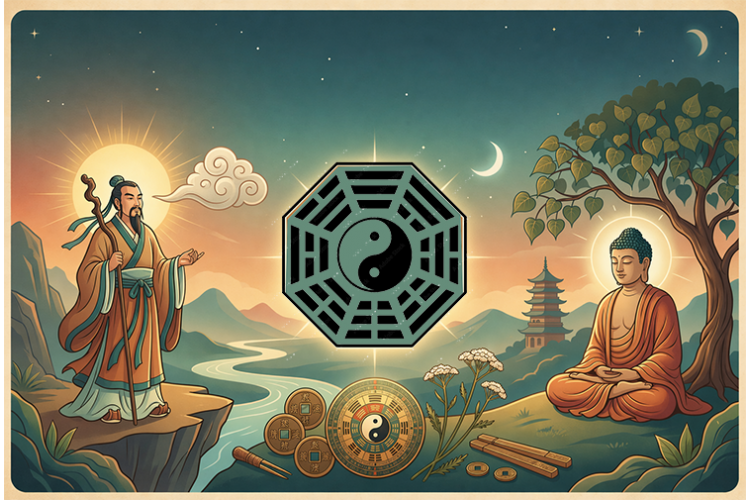
Recently, I've seen some interesting discussions on social media. Someone claimed that Bazi (the Four Pillars of Destiny) does not originate from the I Ching, but rather from the Huangdi Neijing (The Yellow Emperor's Inner Canon). This made me realize that many people still cannot distinguish the fundamental concepts of Chinese metaphysics, or even the basic differences between Taoism and Buddhism. Therefore, I’ve decided to clarify the roots of these traditional wisdoms today.
I Ching Divination: The Source Code of Chinese Philosophy
First and foremost, it must be clarified that the foundation of Chinese philosophy—whether Confucianism or Taoism—finds its theoretical core in the Yin-Yang, Five Elements, and the "Unity of Heaven and Humanity" concepts from the I Ching. In modern terms, the I Ching is a semiotic system that demonstrates the laws of change within the space-time of the universe.
In the traditional Chinese classification of literature (經 Jing, 史 Shi, 子 Zi, 集 Ji):
- Jing (Classics): Represents core classical theories, with the I Ching at the very top of this category.
- Zi (Masters): Covers various schools of thought, religions, technologies, and "Fangshu" (occult arts).
All occult arts derived from the I Ching, including the currently popular fortune-telling methods (such as Bazi, Zi Wei Dou Shu, and Qimen Dunjia) and I Ching divination (such as Wen Wang Gua and Mei Hua Yi Shu), are categorized under "Zi." Notably, Traditional Chinese Medicine (TCM) is also found here. Taoism summarizes these into the "Five Arts": Mountain (cultivation), Medicine, Life (destiny), Divination, and Physiognomy. "Medicine" and "Destiny" share the same origin, both stemming from the cosmology of the I Ching.
Taoism, Buddhism, and the Evolution of Immortals
Among mainstream Chinese ideologies, only Taoism highly emphasizes spiritual cultivation. Taoism advocates observing astronomy above and geography below, believing that "destiny" can be changed and that humans can become Immortals through cultivation. In contrast, Confucianism focuses more on accumulating virtue in this life and maintains a "respectful distance" from ghosts and gods.
As for Buddhism, it was introduced to China around the late Western Han Dynasty. At that time, folklore regarding ghosts and spirits was prevalent. After Buddhism's arrival, the concept of "Six Paths of Reincarnation" was established. To spread locally, Chinese Buddhism absorbed a significant amount of Taoist thought, leading to the emergence of Zen (Chan). Similarly, Taoism absorbed Buddhist elements. Today, seeing devotees worshiping Buddha at a Taoist temple (like Wong Tai Sin) is perfectly logical within Taoist theory: in their view, Buddhas and Bodhisattvas are simply enlightened beings who became "Immortals" long ago.
The True Stance of Religions on "Fortune-Telling"
Interestingly, orthodox Buddhism does not actually advocate for seeking signs from gods or divination; in this regard, it is similar to Christianity. Christianity holds that God is the supreme ruler and that one should communicate through prayer rather than fortune-telling. Buddhism leans more toward the internal development of the mind. However, to facilitate the spread of the Dharma to the masses, Buddhism also evolved a set of divination tools—specifically the "Wooden Wheel Method" from the Sutra on the Divination of Divine Retribution of Good and Evil Actions by Ksitigarbha Bodhisattva.
My personal view is this: all Immortals, Buddhas, Bodhisattvas, or the Lord Jesus are high-level life forms existing in another dimension of the universe. If the laws of the universe are a series of programming codes (the "Tao"), they are beings who have attained "System Administrator" privileges.
When mortals can tune their consciousness to a specific frequency, they can communicate with them. Since they are administrators, they naturally have the ability to fine-tune the system code to help your wishes manifest in reality. Of course, this is just my personal "metaphysical" musing. I wonder, how do you all view this "Universe Code Theory"?
Explore More Mysteries of Destiny
If you are interested in I Ching divination or personalized fortune-telling planning, feel free to follow my latest updates or seek professional advice.
- ✦ Professional Feng Shui Survey and Layout
- ✦ In-depth Bazi and Zi Wei Dou Shu Analysis
- ✦ Online I Ching Divination Services
Leave a Comment