
Feng Shui Insights
I recently came across a popular ezone article explaining in detail how to use Gemini or ChatGPT to assess the feng shui of your home. The article even included more than 10 practical prompts and a four-step communication method. This has sparked curiosity among many traditional feng shui enthusiasts and online readers: “Master, will AI eventually be able to replace feng shui practitioners completely?”
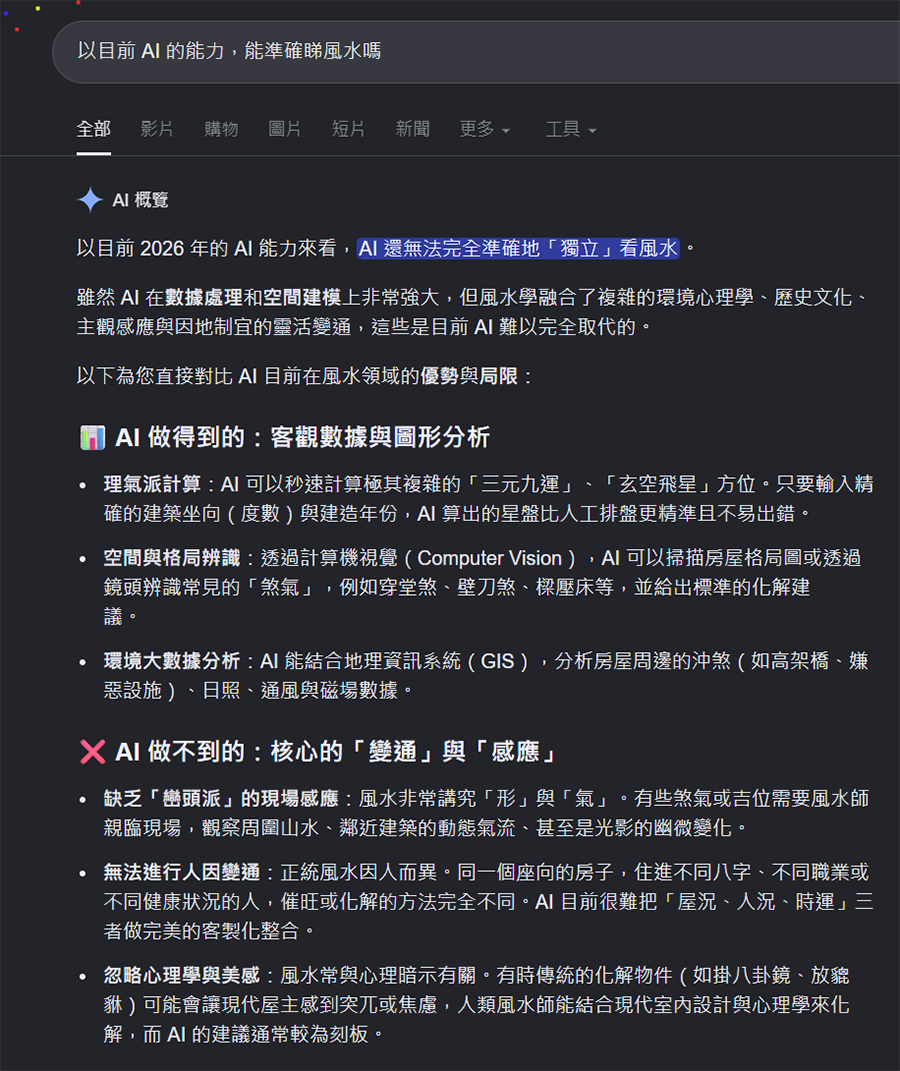
Professional reminder: As a professional Hong Kong feng shui master, I must responsibly tell everyone that current AI cannot yet assess feng shui accurately. It is fine to use it for casual entertainment, but please do not take its conclusions too seriously.
- AI has insufficient ability to understand floor plans and spatial layouts
- AI has not yet mastered traditional feng shui theories
- Users often make errors when determining a property's facing direction
- Feng shui does not work simply by placing a few objects around the home
- Conclusion: Destiny analysis can be formula-based, while feng shui must suit local conditions
- Frequently Asked Questions (FAQ)
Four Major Technical Limitations and Practical Challenges
-
AI has insufficient ability to understand floor plans and spatial layouts
Current artificial intelligence technology is already highly advanced in generating images and videos. However, it still frequently makes mistakes when asked to correctly analyse a floor plan or photographs of a home interior. After all, AI does not possess the intuitive visual perception or on-site awareness of a human practitioner.
If you provide it only with an exterior image of a building or a photograph of the surrounding outdoor environment, it is difficult for AI to conduct an on-site-style assessment like a real feng shui master and analyse external landform factors, known as luan tou, such as a road directly facing the property, sharp-cornered structures, or the “Heavenly Slash” formation. The same applies indoors: based solely on photographs or hand-drawn plans, AI cannot reliably determine the true orientation of a particular area or accurately assess how the current furnishings in that location affect the overall energy of the home.
-
AI has not yet mastered traditional feng shui theories
Feng shui has a long history and contains many schools of thought, including the Eight Mansions School, Xuan Kong Flying Stars, and the San He School. In real-life feng shui assessments, practitioners normally combine several theories to form a comprehensive analysis rather than relying on a single method. Even masters from different lineages may interpret the same layout differently—each school has its own methods.
Although you may specifically instruct AI to use the Nine Palace Flying Stars theory, it may still calculate annual flying stars or feng shui charts incorrectly. Pure calculation errors may be resolved over the coming years as technology improves, but AI's understanding and command of complex feng shui systems remain insufficiently mature at present.
-
Users often make errors when determining a property's facing direction
This issue is not actually caused by AI itself, but by errors in the basic information supplied by the user. For example, the ezone article recommends that readers stand at the centre of their home, face the main door, and use a mobile phone to measure the direction. This approach is generally suitable only for traditional Chinese houses, where the main entrance is located directly at the front of the property.
However, for modern buildings—especially high-rise flats in Hong Kong—determining a property's sitting and facing directions is far more complex than simply facing the front door. A professional feng shui master must assess the exterior structure of the entire development, the arrangement of its blocks, the overall orientation of each block, surrounding environmental airflow, and the interior layout before accurately establishing the property's orientation. If the initial orientation is wrong, every auspicious or inauspicious direction subsequently calculated by AI will also be wrong.
-
Feng shui does not work simply by placing a few objects around the home
The ezone article mentions that, after locating the Wenchang or academic-success sector, placing four evergreen plants there completes the arrangement. In reality, a proper feng shui adjustment is far from such a simple or mechanical process.
When carrying out a feng shui arrangement, a professional practitioner first examines what objects are currently placed in the Wenchang area, whether the location has sufficient natural light and ventilation, and what spaces lie on its left and right sides. The practitioner then analyses the Five Elements relationships among the flying stars to determine whether the Wenchang energy is being enhanced or restrained. Only then can an appropriate remedy for negative influences or a method for strengthening beneficial energy be recommended.
Conclusion: Destiny analysis can be formula-based, while feng shui must suit local conditions
Of course, artificial intelligence is developing at an astonishing pace. I do not rule out the possibility that, in a number of years, AI may be able to produce reasonably good analyses like a genuine feng shui practitioner. For example, I also offer free online BaZi fortune analysis, which is AI-assisted, because BaZi involves formula-based calculations using the Heavenly Stems and Earthly Branches. Its theoretical system is relatively standardised, making it easier for AI to perform consistently. Feng shui, however, involves the interaction of environmental space, timing, terrain, and human activity, making it much more complicated than BaZi analysis.
That said, the ezone article does contain a number of correct and useful basic feng shui concepts. Its editor specifically reminds readers that AI feng shui assessments are “for reference and entertainment purposes only”, while also emphasising the principle that “auspicious land is inhabited by virtuous people”. Feel free to read it as an interesting experience, but when making major renovation or home-selection decisions, it is still advisable to engage a professional feng shui master for an on-site assessment if you want an accurate adjustment of your home's energy environment.
Frequently Asked Questions (FAQ)
Q1: Is AI feng shui completely unreliable?
Answer: It would not be accurate to say that it is completely unreliable. It can be useful for learning basic feng shui concepts or for entertainment. However, since AI cannot accurately grasp the actual on-site space or external landform conditions, important decisions should never rely on AI alone.
Q2: Why can AI be used for BaZi fortune analysis but not for feng shui?
Answer: BaZi uses a formula-based calculation of the Heavenly Stems and Earthly Branches according to the year, month, day, and hour of birth, and its theory is relatively standardised. Feng shui, on the other hand, must account for multidimensional spatial information, including the geographical environment, building structure, physical lighting, and airflow, making it far more complex.
Would you like an accurate feng shui adjustment plan for your home?
You are welcome to contact me at any time to arrange a professional feng shui consultation service, tailored to create an auspicious energy environment for your home.
Leave a Comment