
The Five Elements and the Four Classical Elements | Analysis of Feng Shui Five Elements and Directions
Introduction
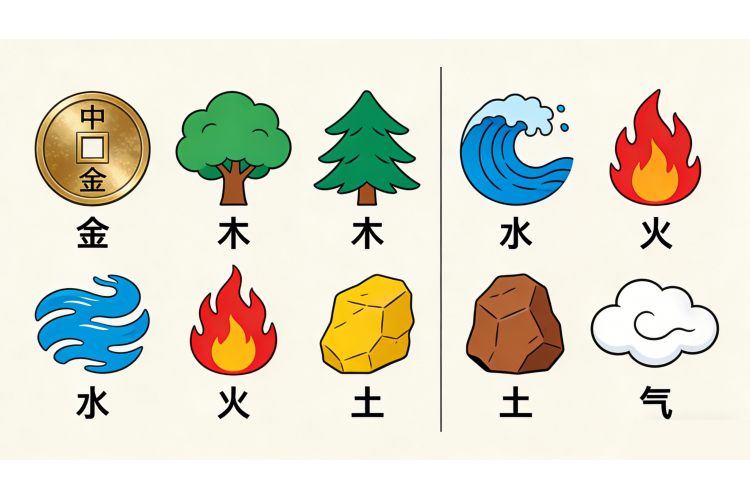
Since ancient times, humanity has constantly pursued a fundamental question: What is the source of the world? From what did all things arise, and where will they return? In the East, ancient Chinese ancestors constructed a dynamic, flowing cosmic model using the Five Elements (Jin, Mu, Shui, Huo, Tu); in the West, ancient Greek philosophers described the foundation of the material world through the Four Elements (Earth, Water, Fire, Air/Wind). While the two appear similar—with Water, Fire, and Earth overlapping completely—they essentially moved in radically different directions. It is particularly noteworthy that the fixed correspondence between the Chinese Five Elements and Feng Shui directions is a unique feature unseen in other ancient civilizations. The roots of this characteristic can be traced back to the long-standing tradition of ancient Chinese ancestors using "gnomon shadow measurement" (Li Gan Ce Ying) to distinguish direction and time, which ultimately profoundly influenced the birth and development of Feng Shui.
Origins of the Ancient Greek Four Elements Theory
From Mesopotamia to the Mediterranean
The source of the Four Elements theory did not begin in mainland Greece. Ancient Babylonians and Egyptians lived by great rivers; the periodic flooding of the Nile and the Euphrates brought fertile soil, leading them to be the first to view "Water" and "Earth" as the basic components of the world. Since civilized society inevitably used fire for cooking, "Fire" was also indispensable. These simple elemental concepts subsequently spread to the ancient Greek world along the Mediterranean coast (Wikipedia).
From a Single Source to the Coexistence of Four Elements
Ancient Greek philosophers held differing opinions when facing the proposition of "What is the source of the world?" In the 7th to 6th centuries BCE, Thales, hailed as the "father of science and philosophy," claimed that "all things are from water, and all things return to water." It is said he traveled to Egypt and was deeply inspired by the vastness of the Nile. His student Anaximenes believed that Air was the source, and that Water was merely liquefied Air. Later, Xenophanes proposed Earth as the source, while Heraclitus insisted that Fire was the foundation of all things.
The various schools argued incessantly until Empedocles integrated them around 450 BCE in his work *On Nature*. He proposed that Fire, Earth, Air, and Water were the four "roots" (rhizomata) of the world; all things are generated by the combination of these four roots and vanish by their separation. This was the formal establishment of the Four Elements theory. Empedocles also believed that the four elements were not only the components of the material universe but also the essence of spirituality, mapping each element to a deity—Zeus represented Air, Hera represented Earth, Hades represented Fire, and Nestis represented Water.
Aristotle's Innovation
However, at this stage, the four elements were still isolated and static, like four building blocks mechanically arranged together. It was Aristotle who truly popularized the Four Elements theory. He believed that the four elements possessed perceptible pairs of opposing qualities—Hot, Cold, Dry, and Wet. By combining these properties, the four elements could transform into one another, constituting all things in the world. The static became dynamic, and the isolated became transformable. This modification was epoch-making.
Aristotle also proposed a fifth element—Aether, representing the eternal substance of the heavenly realms. His theory of elemental transformation greatly influenced Western culture, from medicine to alchemy. The famous ancient Greek physician Hippocrates proposed the "Humorism" theory based on this, believing the human body consists of four humors—blood, phlegm, yellow bile, and black bile—corresponding to the four elements.
Spread: From Greece to India
The four elements spread to ancient India following Alexander the Great's eastern campaigns, forming the theory of the "Four Great Elements" (Earth, Water, Fire, Wind), later adding "Void" (Akasha) to become the Five Greats. These concepts were widely integrated into Buddhist and Hindu cultures; the term "All four elements are void" originated from this. The Buddhist "Four Greats" then spread to China and Tibet, colliding and merging with indigenous thoughts.
Origins of the Chinese Five Elements Theory
First Appearance in Literature
Every Chinese person can recite them: Metal (Jin), Wood (Mu), Water (Shui), Fire (Huo), Earth (Tu). The Five Elements first appeared in the "Great Plan" (Hong Fan) section of the *Book of Documents* (Shang Shu): "The Five Elements: first is Water, second is Fire, third is Wood, fourth is Metal, fifth is Earth. Water is said to soak and descend; Fire is said to flame and ascend; Wood is said to be curved or straight; Metal is said to follow and reform; Earth is said to be for sowing and reaping." This document reportedly records King Wu of Zhou consulting Jizi on the way of governance after the fall of the Shang Dynasty. Jizi listed nine priorities, with the Five Elements ranking first (Chinese Social Sciences Net).
Academia generally believes that the "Great Plan" was written during the Warring States period, and the first person to systematically propose the Five Elements theory was Zou Yan, a Yin-Yang philosopher from the State of Qi. He proposed four far-reaching theories: the Yin-Yang theory, the Five Elements theory (including the cycle of generation and conquest), the theory of the Five Virtues (explaining dynastic changes through elemental virtues), and the Great Nine Continents theory. The concept of Five Elements also appears multiple times in the *Zuo Zhuan*, such as in the 27th year of Duke Xiang: "Heaven produces the five materials; the people use them all, and not one can be discarded."
Five Elements Originate from Five Directions—The Crucial Difference
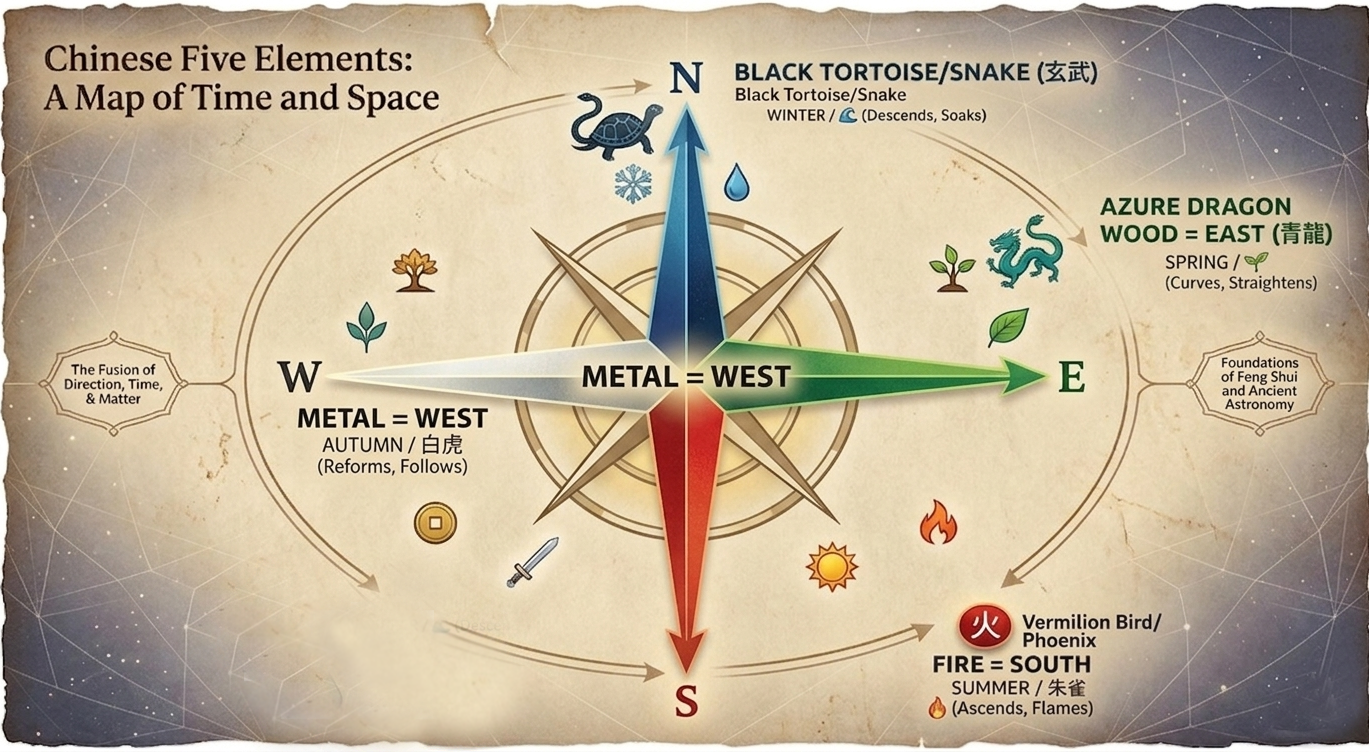
Comparing the Four Elements with the Five Elements, the most striking difference is: the Five Elements correspond to five fixed Feng Shui directions, whereas the Four Elements are not tied to any direction.
- Wood → East
- Fire → South
- Earth → Center
- Metal → West
- Water → North
These five correspondences are immutable. The arrangement of the ancient Greek four elements could be swapped at will—Water in the South, Air in the East, Fire in the North—all would be acceptable. But the Feng Shui directions of the Five Elements cannot be misplaced.
This difference reveals the true origin of the Five Elements. According to research by oracle bone script expert Hu Houxuan in *Research on the Names of the Four Directions and Winds in Oracle Bone Inscriptions*, the Five Elements originated from the "Four Directions Sacrifices" of the Shang Dynasty. The Shang people sacrificed to the East, West, South, and North. The direction "Shang" was initially located in the Northeast, indicating they may have come from there. After Pan Geng moved the capital to Yin, the location of "Shang" shifted to the center. Therefore, the Shang period originally only had the concept of "Four Directions," but by the Western Zhou, the Zhou people added the "Center," forming the "Five Directions" system. It was precisely because of the "Five Directions" that the "Five Elements" emerged.
Japanese scholar Satoshi Inoue also argues that the Five Elements originated from Western Zhou rituals for the five directions. The transition from "Four Directions" to "Five Directions" was vital—China's name, "Zhongguo" (the Middle Kingdom), exists precisely because the Zhou people established the consciousness of the "Center." The early Western Zhou bronze vessel, the He Zun, has the two characters for "Zhongguo" engraved on its base, meaning "the country in the center."
The Integration of the Four Symbols and Five Elements
The Four Directions sacrifices of the Shang were preserved in the Zhou Dynasty as the "Four Symbols." These are the four mythical beasts—Azure Dragon of the East, White Tiger of the West, Black Tortoise of the North, and Vermilion Bird of the South—which also correspond to the four groups of constellations among the Twenty-Eight Mansions. This system was later perfectly absorbed by the Five Elements: Azure Dragon of the East belongs to Wood (Green), White Tiger of the West belongs to Metal (White), Black Tortoise of the North belongs to Water (Black), Vermilion Bird of the South belongs to Fire (Red), and the Center belongs to Earth (Yellow), overseen by the Great Emperor of the Purple Tenuity.
East-West Comparison: Essential Differences
| Dimension | Ancient Greek Four Elements | Chinese Five Elements |
|---|---|---|
| Elements | Earth, Water, Fire, Air (Wind) | Metal, Wood, Water, Fire, Earth |
| Overlapping Elements | Water, Fire, Earth | Water, Fire, Earth |
| Number of Elements | Four (Aristotle added Aether as a fifth) | Five |
| Directional Correspondence | No fixed directions | Five fixed Feng Shui directions (E, S, W, N, C) |
| Relationship | Early on: isolated/static; after Aristotle: transformable | From the start: dynamic cycles of generation and conquest |
| Ideological Root | Philosophical inquiry into material origins | Sacrifices and observations of astronomical directions |
| Time Concept | Not directly tied to seasons (later associated) | Fixed correspondence to Five Seasons (Spring, Summer, Late Summer, Autumn, Winter) |
| Medical Application | Four Humors Theory | Five Zang-organs, Six Fu-organs, Meridian system |
| Key Figures | Empedocles, Aristotle | Zou Yan |
The most fundamental difference between the Five Elements and the Four Elements is that the latter is pure "materialism," asking "What is the world made of?"; whereas the Five Elements is a trinity system of "Direction—Time—Matter," asking not only "What is it made of?" but also "Where is it?" and "When is it?" This profound concern for Feng Shui direction and time is the most unique imprint of Chinese culture.
Gnomon Shadow Measurement: The Chinese Obsession with Direction and Time
From a Bamboo Pole to Astronomical Instruments
The importance placed on direction by ancient Chinese was not unfounded but built upon long-term and precise astronomical observations. The idiom "Li Gan Jian Ying" (seeing the shadow as soon as the pole is set) originally referred to erecting a bamboo pole under sunlight to observe shadow changes—this was China's oldest astronomical measurement method (People's Daily Overseas Edition).
The "Biao" is the vertical pole, also known as "Li Biao" or "Nie"; the "Gui" is a horizontal ruler placed in the north-south direction to measure shadow length. At noon, when the sun is due south, the shadow falls exactly on the Gui ruler—the shadow is shortest at the Summer Solstice and longest at the Winter Solstice. By recording these changes, ancestors could accurately determine solar terms, seasons, and Feng Shui directions.
Physical Evidence from 4,000 Years Ago
A lacquered wooden pole with alternating black, green, and red colors was unearthed at the Taosi site in Shanxi. Scholars speculate this is the earliest physical gnomon instrument discovered archaeologically, dating back roughly 4,300 to 4,000 years. The pole is lacquered black and decorated with green and pink bands; the total length of segments 1 to 11 is 39.9 cm, which aligns closely with the record in the *Zhou Bi Suan Jing* stating "shadow length at Summer Solstice is one chi and six cun" (Tencent News).
By 6,500 years ago, ancient Chinese already had substantial experience in "gnomon shadow measurement." By the Zhou Dynasty, the standard height for the pole was eight chi (about 267 cm). From the Han Dynasty onward, precise written records of the Gui-Biao appeared. Yuan Dynasty scientist Guo Shoujing even expanded the traditional eight-chi height into architectural "high gnomons," with the Dengfeng Observatory being his masterpiece (Beijing Planetarium).
Determining Direction and Correcting Position: The Practical Basis of Directional Awareness
The core function of shadow measurement was not just "measuring time" but "determining direction." The *Rites of Zhou* clearly states that to build a royal capital, one must first determine the "Center of the Earth" (Di Zhong), which was achieved by measuring the shadow length at the Summer Solstice. This concept originated from an ancient cosmic view and is the source of political consciousness like the "Middle Way" and "Orthodoxy."
The Beijing Planetarium notes more precisely: ancients would "examine shadows by day and observe the Pole Star by night to correct morning and evening." During the day, they used the pole to find true north and south; at night, they used the North Star for calibration. The term "Gui Nie" (standard/criterion) derived its meaning from this instrument used to fix Feng Shui directions.
The oracle bone character for "Middle" (Zhong) resembles a wooden pole with ropes standing in the center of the ground, vividly reflecting the practice. The term "Li Zhong" (establishing the center) records the Shang practice of determining directions and solar terms through shadow measurement.
From Direction to Feng Shui: The Interweaving of Time and Space
The Essence of Feng Shui: Relationships between Direction, Time, and Space
Feng Shui literally means "Wind and Water." Its core principle lies in "Qi disperses when riding the wind and stops at the boundary of water." However, the true essence of Feng Shui goes far beyond this—it is a complete system centered on Feng Shui direction that interweaves time and space.
Feng Shui can be traced back to legendary ancient times. The *Classic of Poetry* mentions "observing the Yin and Yang," and the *Book of Documents* mentions "divining the site of Luo." Archaeological analysis shows the essence of Feng Shui is "observing heaven and surveying earth," "evaluating soil and tasting water," and "planning the state and determining positions"—namely, examining astronomy and geography to fix orientation (Sohu Academic).
Pre-Qin settlement construction already embodied the embryonic form of Feng Shui: Yaocheng of the Zhou and Yindu of the Shang both emphasized facing south with mountains at the back and water in front. The *Rites of Zhou: Kaogongji* records the principle that a capital should "face south, lean against the north, have flowing water on the left, and high hills on the right." Houses at the Banpo site in the Yellow River basin faced specific constellations to maximize sunlight during the Winter Solstice—this harmony with nature is the sprout of Feng Shui thought.
Direct Connection between Shadow Measurement and Feng Shui
The method of "determining direction and correcting position" in Feng Shui was originally "erecting a pole to measure shadows by day and observing the Ding star (Markab) by night." The shadow pole was also called "Tu Gui" (Earth Ruler). In the lineage of Feng Shui, the pole method evolved into the "Jade Ruler" and "Dao Zhang" methods.
It was through the long-term practice of various Feng Shui schools seeking "unity of heaven and man" in architecture that ancestors combined the "Tu Gui" with "Heavenly Time" (the Shi-divination board). Passing through the Han Dynasty's "Si Nan" (South-Pointer) made of natural magnetite, the invention of the compass was finally completed after the Tang Dynasty. By comparing the compass with shadow measurement, they discovered magnetic declination. Joseph Needham called the compass one of "China's greatest contributions to science," and the direct driver of its invention was the relentless pursuit of precise Feng Shui direction.
The Compass (Luo Pan): The Ultimate Manifestation of Directional Awareness
The history of the Feng Shui compass is a microcosm of the continuous refinement of directional consciousness. The Warring States Si Nan was the earliest pointing instrument. Tang Dynasty Feng Shui master Yang Yun-song redesigned the compass, merging the Eight Trigrams with the Twelve Earthly Branches and adding the Heavenly Stems to indicate Feng Shui directions, dividing the Earth Plate into twenty-four equal parts known as the "Twenty-Four Mountains." Song Dynasty master Lai Bu-yi added the Human Plate specifically for neutralizing negative energy (Sha Qi). Thus, the basic framework of the Feng Shui compass was established, covering the Heavenly, Earthly, and Human Plates.
The two major schools of Feng Shui—the Form School (Luan Tou) and the Compass School (Li Qi)—both center on Feng Shui direction. The Form School observes the contours of mountains and rivers, mapping the Four Spirit Beasts to the cardinal Feng Shui directions. The Compass School uses the Luo Pan to precisely measure angles, combining the Eight Trigrams, Five Elements, and stems/branches to analyze the flow of Qi.
Flying Star Feng Shui: Injecting Time into Direction
Xuan Kong Flying Star (Fei Xing) is the most representative branch of the Compass School and the school that most systematically integrates the "Time" dimension into Feng Shui direction. "Xuan" represents the movement of heavenly phenomena (Time); "Kong" represents Space. The core of Xuan Kong Feng Shui is the interaction between time and space that produces changes in fortune—this makes it one of the most logically rigorous and complete systems in Feng Shui.
The theoretical basis of Flying Star is the "Three Eras and Nine Periods": 180 years make one grand cycle, divided into Upper, Middle, and Lower Eras (60 years each). Each Era is further divided into three Periods of 20 years, totaling Nine Periods. The Nine Periods Feng Shui correspond to the nine stars of the Big Dipper—1 White, 2 Black, 3 Jade, 4 Green, 5 Yellow, 6 White, 7 Red, 8 White, and 9 Purple. Each star dominates the Feng Shui directional energy pattern when it is "in command" (Timely). The origin of this system stems from ancient astronomical observations: sages found that roughly every 20 years, Jupiter and Saturn align, triggering major changes on Earth, leading to this precise Nine Periods Feng Shui calendar.
Jiang Dahong of the Qing Dynasty is honored as the founder of the Xuan Kong school, advocating for the use of the Nine Palace Flying Stars combined with the Three Eras and Nine Periods to measure energy cycles. Later popularized by Zhang Zhongshan and Shen Zhureng, Xuan Kong Flying Star became a prominent academic study. Its operation originates from the Luo Shu: the nine stars fly through nine palaces following a specific track. Any building's Feng Shui direction fortune can be judged by overlapping the Period, Mountain, and Facing charts.
We are currently in a critical phase of Lower Era Nine Periods Feng Shui—Period 9 (2024–2043), where the 9 Purple Fire Star is in command. This means that in the Nine Periods Feng Shui pattern, the energy of the South (Li Trigram) Feng Shui direction is most vibrant. Orientations toward the South or layouts with Period 9 stars often benefit from the current timing. This is the core view of Xuan Kong: the same Feng Shui direction has completely different auspicious or inauspicious attributes in different time periods. This is the true meaning of "Feng Shui luck rotates"—auspiciousness is not fixed but transforms with time. This perfectly validates the essence of the Five Elements: they are not static material categories, but a dynamic system interweaving Feng Shui direction, time, and energy.
The Core Logic of Feng Shui: Direction × Time × Space
What distinguishes Feng Shui from spatial concepts in other civilizations is its focus not only on "where the space is," but also "when the time is" and the dynamic relationship between them. Northern Song scholar Shao Yong and others combined I Ching studies with Feng Shui to explore the relationship between house fortune and time, forming theories like the "Eight Mansions School" (Ba Zhai). Xuan Kong Feng Shui deeply integrated the time dimension (Periods) with spatial Feng Shui direction, believing that the same direction exhibits different qualities over different periods.
This is the extension of Five Elements thought: they correspond to five directions (space) and five seasons (time)—Wood to Spring, Fire to Summer, Earth to Late Summer, Metal to Autumn, and Water to Winter. Feng Shui applies this correspondence system to actual site selection and interior layout, making every building a node where "Heavenly Timing, Earthly Advantage, and Human Harmony" converge.
Collision of Five Elements and Four Elements
Buddhist "Four Greats" Enter China
When the Indian Four Elements entered China with Buddhism, they collided with the indigenous Five Elements theory. Master Yunqi Zhuhong (Lianchi), one of the four great monks of the late Ming, discussed this in his *Bamboo Window Essays*. He argued that "Metal" is contained within "Earth" and "Wood" is contained within "Wind," thus the Four Greats and Five Elements can be reconciled.
Matteo Ricci's Critique
In the late Ming, missionary Matteo Ricci introduced the ancient Greek Four Elements in his *On the Heavens and Earth* (Qiankun Ti Yi), while criticizing the Five Elements theory, arguing that Metal and Wood should not be classified as elements. He grouped Water, Fire, Earth, and the traditional "Qi" as the "Four Actions" (Si Xing) and found a Taoist name for "Air"—"Qi" (炁). However, these views were not widely accepted, and the Five Elements theory remains prevalent to this day.
Conclusion: Directional Awareness Shaped Chinese Civilization
Reviewing the origins of the Five Elements and the Four Elements, a clear thread emerges: the sensitivity and obsession of the Chinese people regarding Feng Shui direction is a main theme running through thousands of years of history.
From the Four Directions sacrifices of the Shang to the Five Directions system of the Western Zhou, from the "Li Zhong" in oracle bones to the lacquered gnomon of Taosi, from "determining positions" in the *Rites of Zhou* to the Twenty-Four Mountains on the Feng Shui compass—ancient Chinese ancestors were always asking: Where am I? Which direction? What time is it now? How do direction and time influence each other?
It was these questions that gave birth to the Five Elements theory—a grand system integrating Feng Shui direction, time, matter, color, seasons, organs, and even virtue. It was also these questions that birthed Feng Shui—a practical discipline centered on Feng Shui direction exploring the dynamic relationship between time and space, pushed to a precise spatio-temporal mathematical system by schools like Xuan Kong Flying Star and Nine Periods Feng Shui.
The ancient Greeks asked "What is the world made of," while the Chinese asked "Where and when is the world moving." The former developed into atomism and modern chemistry; the latter into Feng Shui and Traditional Chinese Medicine. Both paths are crystallizations of human wisdom, but the binding of Five Elements to Feng Shui direction and the long tradition of shadow measurement led Chinese civilization down a unique path.
British scholar Joseph Needham once remarked: "The only thing wrong with the Chinese Five Elements theory is that it was popular for too long." This is both a critique and an admiration—a theory born thousands of years ago is still deeply rooted in Chinese daily life, architectural practice, and cultural imagination today, which in itself speaks to its irreplaceable vitality.
The Five Elements will not die because direction is eternal. As long as the sun rises in the East and sets in the West, as long as a pole can cast a shadow, the wisdom of the Five Elements will continue to flow. The wisdom of Feng Shui will also continue to evolve with every new Period—including the current Nine Periods Feng Shui era—writing an eternal dialogue between time and space between heaven and earth.
Explore the Millennial Wisdom of Feng Shui and Five Elements
From Five Elements directions to Xuan Kong Flying Star, from shadow measurement to Period 9 Feng Shui—traditional Chinese wisdom covers the complete system of time, space, and energy. Whether you are a beginner or a deep researcher, this ancient knowledge will bring a fresh perspective to your life and space.
- ✦ Understand how Five Elements directions affect your home layout
- ✦ Master the era energy of Period 9 Feng Shui (2024–2043)
- ✦ Apply Flying Star principles to optimize spatial fortune
- ✦ Explore the dynamic wisdom of interwoven direction and time
Leave a Comment