
A Brief History of Feng Shui
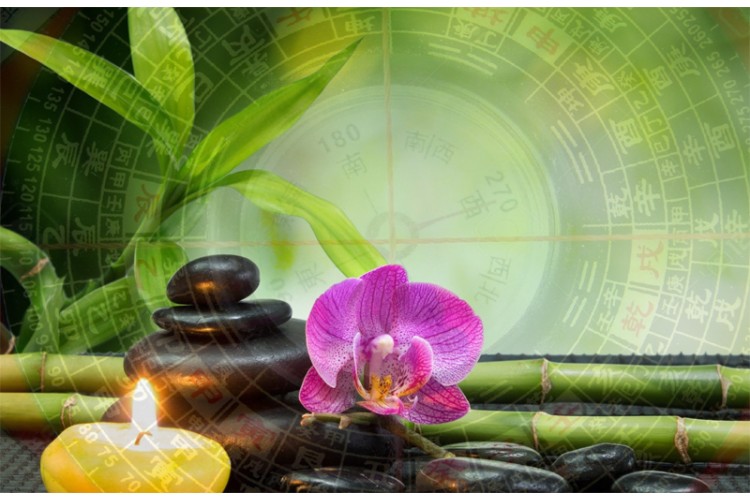
Feng Shui's history is said to date back 2,500 years. To truly understand it, we must trace its origins and cultural-sociological context. Feng Shui began with ancient Chinese observations of humanity's relationship to the natural environment and the ever-changing cycles of nature that influence human life.

The Discovery of Qi: Feng Shui's Philosophical Foundation
Human well-being is intimately connected to nature. The ancients gradually discovered auspicious and inauspicious directions, favorable timings, and spacetime environments harmful to people. To live in harmony with their surroundings, people needed to understand their environment; this desire for understanding evolved into the ability to predict natural changes.
One way to understand nature was recognizing an omnipresent energy flowing through all things, governing natural processes and life's creation—this energy is called Qi. Qi has multiple dimensions, containing both positive and negative aspects that interact and connect. The ancients expressed these dual forces symbolically, giving birth to Yin-Yang dualism: two opposing yet inseparable forces constantly creating new phenomena.
"Perhaps by influencing one aspect, we can redirect Qi's flow—whether Sheng Qi (beneficial energy) or Sha Qi (harmful energy)—to create new outcomes."
Form School: Human-Environment Interaction
The ancients focused more on the universal laws guiding Qi's movement than on change itself. Not only do environments interact with each other, but humans can also interact with and influence their environments for their benefit. This thinking forms the foundation of Feng Shui's Form School, which emphasizes geography and natural landforms.
Compass Invention & Tang-Song Feng Shui Revolution
Yang Yun Song: Birth of the Luopan
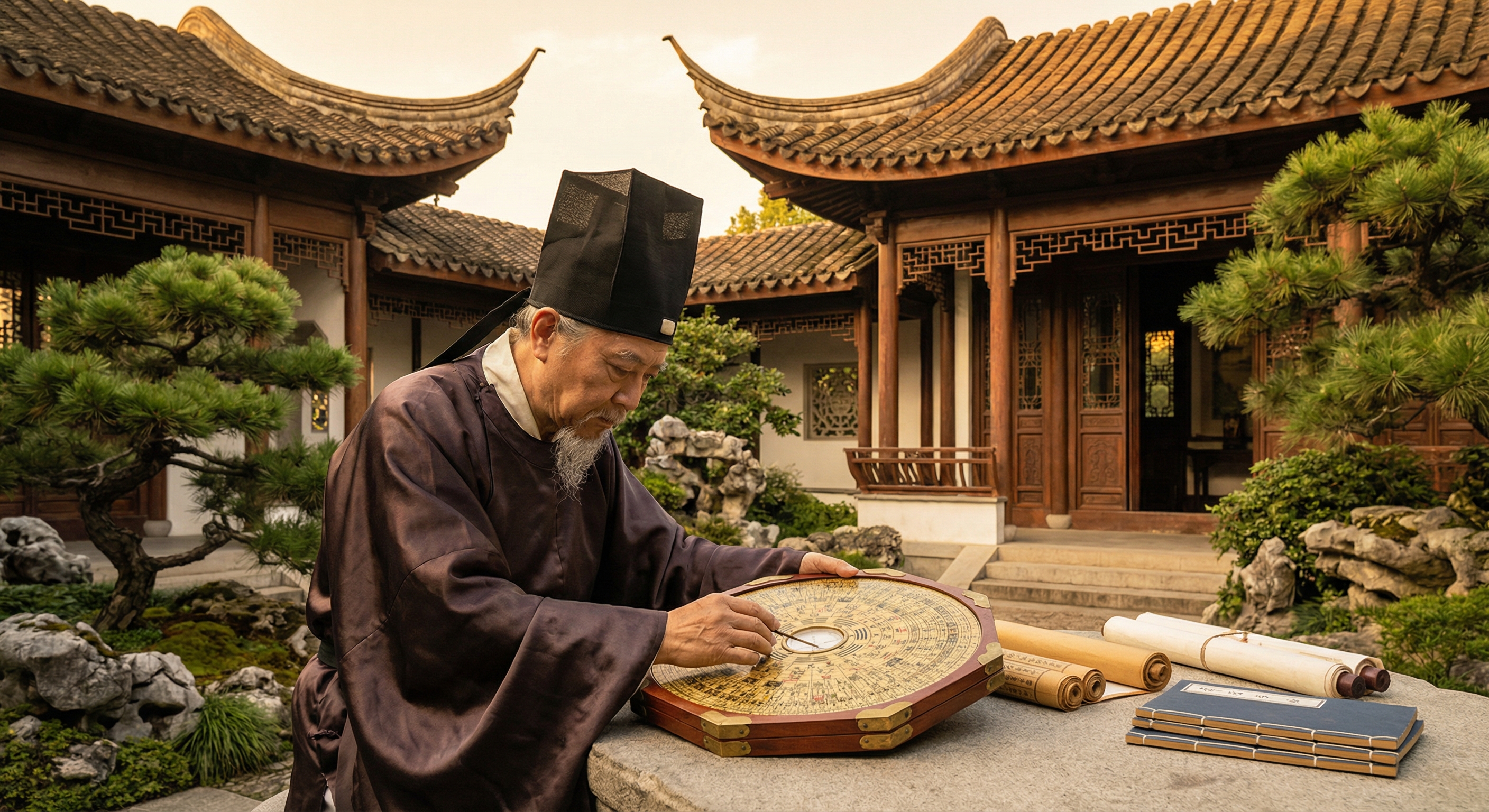
During the Tang Dynasty, Imperial Astronomer Yang Yun Song studied nature's effects on humanity and determined to invent a tool to measure Qi, creating the revolutionary Feng Shui instrument—the Luopan compass.
Burial Feng Shui: Science of Ancestral Blessings
At that time, Feng Shui primarily served the deceased, used to select optimal burial sites. In Chinese culture, respect for elders extended beyond death: parents' burial sites directly affected their descendants' fortunes. Proper burial according to Feng Shui principles brought blessings to oneself and future generations; choosing the wrong site could curse a family for generations.
Song Dynasty Innovation: From Graves to Living Spaces
During the Song Dynasty, Feng Shui master Lai Bu Yi made history by applying burial theory to living residences. He refined the Luopan compass, elevating Feng Shui to a new level of popularity, making the compass an essential tool for every Feng Shui practitioner.
The Diverse Evolution of Feng Shui Schools
Over time, through master-disciple transmission, practitioners adapted teachings according to personal preferences and specialties, creating numerous schools (lineages). The two major systems are:
- Three Harmonies School: Focuses on landforms and environmental shapes
- Three Periods School: Incorporates time factors and heaven-human unity
Feng Shui cannot be defined as a single theory; each major school contains numerous branches and methods, contributing to its colorful and mysterious nature.
Qi and Cross-Disciplinary Influence
From the core concept "Qi as the fundamental force of all things," numerous ancient disciplines emerged: astrology and astronomy, mathematics, medicine (acupuncture), Chinese cooking (sweet-sour as Yin-Yang balance), agriculture, martial arts, philosophy, and religion. This interdisciplinary connection continues in modern Feng Shui masters, who often study complementary arts like astrology and Ba Zi fortune-telling.
The Perfect Blend of Science and Art
Feng Shui combines mathematical calculations, symbolic element interactions, subjective interpretation, and intuition. Body and mind interact in its application, making Feng Shui a synthesis of science and art. Beyond precise calculations, Feng Shui readings employ metaphorical visualization and vivid imagery:
- Mountains become dragon spines or turtle shells
- Rivers form serpentine curves
- Mountain formations resemble tiger crouching
- Roads curve like drawn bows releasing arrows
Even small household objects interact with Qi and carry profound meaning and symbolism within the Feng Shui context. Feng Shui masters transform universal principles into understandable, actionable life wisdom through symbolic language.
Leave a Comment