
Feng Shui Classroom
In this article, I want to walk you through three major steps to improve the feng shui of your home. Before we dive in, let’s strip away the mystery and look at what feng shui is about. Many people think it’s superstition, or something purely mystical. At its heart, feng shui explores how your living environment interacts with your personal energy.
In traditional terms, we call this energy Qi. In modern, everyday language, we can think about the light, sound, airflow, scent, and subtle environmental elements your body senses every single day. The goal of feng shui is to surround yourself with a clean, harmonious environment that supports your body and mind.
None of us want to live in a space that feels stagnant or heavy. So, how do we improve it without knocking down walls or spending a fortune? Let’s walk through three simple, practical steps.
Step 1: Declutter the Key Energy Pathways
The very first step to better feng shui isn’t buying lucky charms. It’s subtraction. Start by decluttering three critical areas.
1. The Main Entrance: The Mouth of Qi
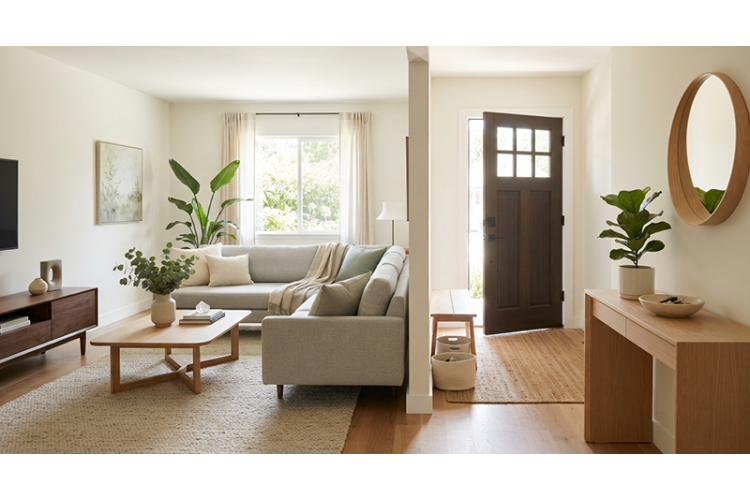
The area both inside and outside your front door should be clear of obstacles. Here is the single biggest mistake I see in almost every home: people walk in, kick off their shoes, and leave them scattered right by the door.
In feng shui, this is considered a major taboo. Shoes carry dust from the outside world and are traditionally associated with stagnant energy. Leaving them at the entrance is thought to interfere with the fresh energy entering your home. Put your shoes away inside a closed shoe cabinet.
2. The Diagonal Wealth Corner
Stand at your front door and look diagonally across to the far corner of your living room. In this approach to feng shui, this is what we call the primary “Wealth Corner.”
Take a look at what’s sitting there right now. If it’s piled up with random clutter or unnecessary knick-knacks, clear them out. If you don’t know what to put in your wealth corner, the best thing to put there is nothing at all. Keeping it clean, bright, and open is already half the battle won.
3. Behind Every Room Door
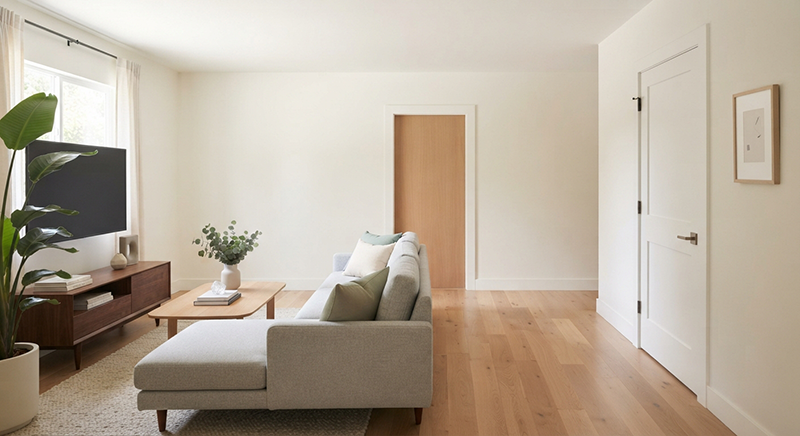
Make sure the spaces behind your bedroom and study doors are unobstructed. In compact city apartments, especially in places like Hong Kong, people love maximizing every square inch by placing storage racks or hanging heavy coats behind their doors. As a result, the door can only open halfway.
In feng shui, a door that cannot open fully symbolizes restricted energy and opportunities. Give your doors enough space to open freely.
Step 2: Diagnose and Fix Common Feng Shui Flaws
Once your home is decluttered, the second step is to give your space a quick “health check.” Take a mental inventory and see if your home has any of these common issues.
-
Doorway clashes:
- Your front door aligns directly with a balcony door or large window. In feng shui, this is thought to allow good energy to rush straight in and right back out.
- A bathroom door directly faces your kitchen door or bedroom door.
- “Water and Fire” clashes in the kitchen: Your stove directly faces the kitchen sink, or you have a washing machine tucked right underneath the stove. In traditional Five Element theory, these arrangements represent a conflict between Fire and Water.
- Lack of support and overhead pressure: Your sofa, headboard, or work chair has empty space or a large window behind it, leaving you without symbolic solid support. An exposed structural beam running directly above your bed is another common feng shui concern.
- Bedroom disruptions: Your bed is pushed too close to the bedroom door, an en-suite bathroom door faces your bed, or a mirror reflects your bed. If catching a reflection in the dark makes you uncomfortable, consider repositioning or covering the mirror.
- Basic environmental imbalances: Poor natural lighting leaves rooms perpetually dim, or stagnant airflow makes the space feel stuffy or damp.
Now, don’t panic if your home checks a few of these boxes! Start with simple, low-cost adjustments rather than assuming you need a major renovation.
- For doorway clashes: Build the habit of keeping doors closed where practical, especially bathroom doors, while maintaining appropriate ventilation.
- For a front door facing a balcony: A decorative screen or waist-high shelving unit can create a gentler transition between the two openings. Keep the walking route clear.
- For the kitchen “Water and Fire” clash: If you can’t remodel your kitchen, the traditional adjustment suggested here is to avoid running the washing machine while cooking on the stove. Treat this as a symbolic feng shui practice, not a substitute for safe appliance installation.
Step 3: Apply Simple Annual Flying Star Adjustments
The first two steps build your home’s foundation. Step 3 is about adapting to time, specifically using Annual Flying Star feng shui to fine-tune your space each year.
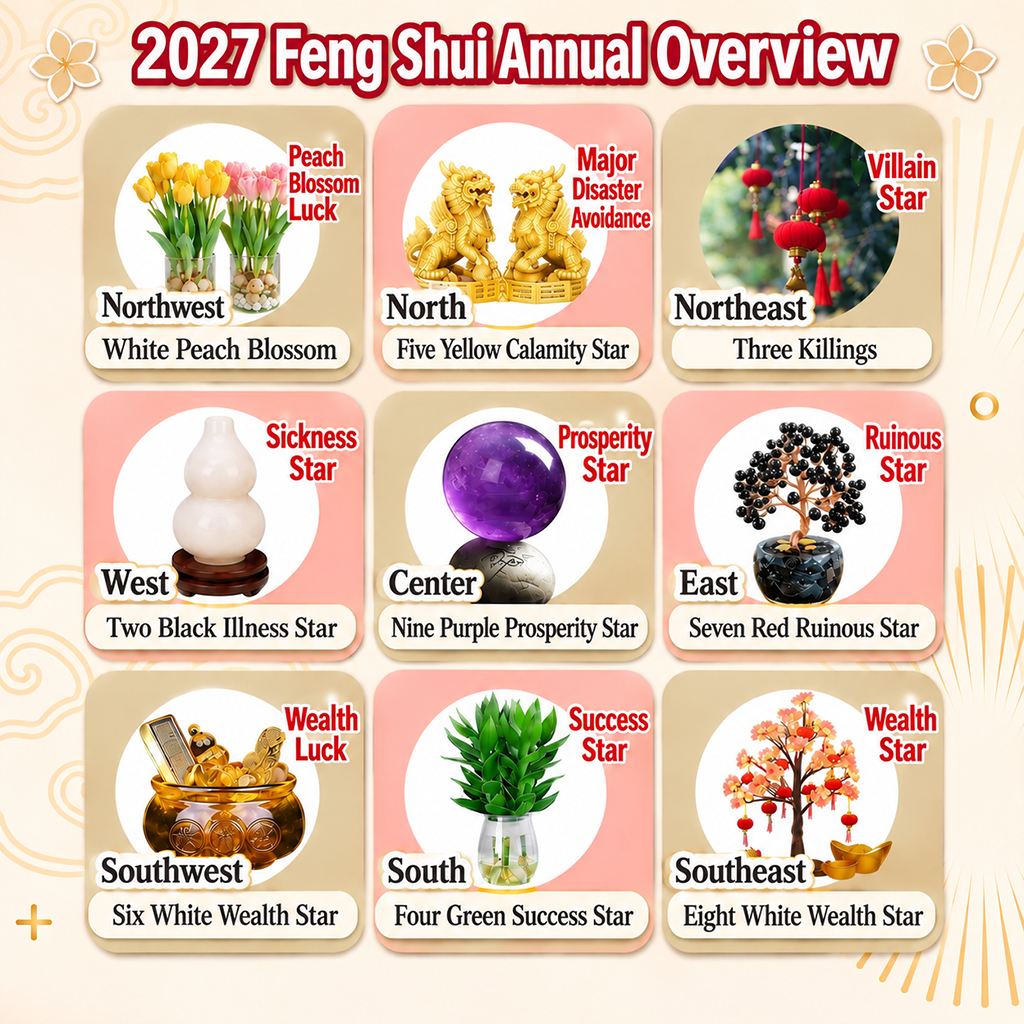
The 2027 Flying Star chart below is a reference for your annual adjustments. Before you start placing items around your house, keep three golden rules in mind.
1. Watch the Calendar
For the annual Flying Star practice described here, the 2026 cycle ends on February 3, 2027, and the 2027 cycle begins on February 4. Prepare to shift your items according to the new year’s chart around that transition.
2. Less Is More
Always declutter a sector before placing anything new there. Most importantly, do not buy every single item on the chart and clutter your entire house!
In this tradition, placing too many remedies without guidance is thought to create conflicting adjustments. Instead, pick just one or two priorities. For example, if you want to focus on your career or wealth next year, concentrate on those one or two sectors.
3. In Unlucky Sectors, “Do Nothing”
Feng shui isn’t about achieving 100% perfection. It’s about balancing Yin and Yang and the Five Elements. In auspicious sectors, the traditional approach is to enhance the energy. In inauspicious sectors, my preferred starting point is non-action.
Simply declutter the area and keep it clean and well ventilated. Rather than adding objects out of worry, keep your adjustments minimal. Within this approach, unnecessary or unsuitable objects are believed to activate unwanted influences.
Tailoring the Five Elements to Your Personal Chart
If you want to take this a step further, it helps to know which of the Five Elements: Wood, Fire, Earth, Metal, or Water, are considered favorable in your personal birth chart. You can check your birth chart for free on my website.
For instance, if the annual chart suggests placing a Fire element in your wealth corner, but your personal chart considers Fire unfavorable, you can dial down the intensity. Instead of bright, aggressive red, choose a soft, pastel pink.
If tracking the Five Elements feels overwhelming, use this simple rule of thumb: keep your adjustments minimal and subtle.
I suggest allowing one to two months before reviewing your changes. If the space feels better and the arrangement works well for you, keep it. If nothing changes, reassess rather than adding more items automatically. If an adjustment makes your home less comfortable, remove it. Changes in health, finances, or relationships should not automatically be attributed to a feng shui object.
Remembering the Golden Hierarchy: Destiny, Luck, and Feng Shui
Finally, I want to leave you with a crucial perspective. When we hit a rough patch in our career or health, we shouldn’t automatically blame our home’s feng shui. In traditional Chinese thinking, a challenging period may also be understood through our personal timeline.
An old Chinese saying sums up this perspective:
“First comes Destiny, second comes Luck, and third comes Feng Shui.”
Within this traditional framework, your innate blueprint and timing sit above your environment. Feng shui isn’t magic that overrides fate. Think of it instead as a supportive tailwind when times are good, and a protective cushion when times get tough, not a guarantee of a particular outcome.
Your Action Plan: Put It into Practice
So, how do you put Step 3 into practice? Start with a smartphone compass and a rough floor plan of your home.
- Find your center and directions: Stand roughly in the center of your home, away from large metal appliances or strong magnets. Open your phone’s compass app, follow its calibration instructions, and locate North, South, East, West, and the four intermediate directions.
- Map your floor plan: Draw four intersecting lines through the center of your floor plan to mark the eight directions. Use these as a simple guide to see which rooms fall into which sectors.
- Place your remedies: Pick one or two target sectors from the chart, declutter them first, and place your chosen items.
The basic process can be kept simple: clear the clutter, address the obvious issues, and make only a few thoughtful adjustments.
Just remember to review your annual placements around February 4, 2027, according to the new year’s plan.
Good luck!
Leave a Comment